


The First Anfal Genocide-1988
The First Anfal Genocide (23 Feb – 19 Mar 1988)
The Anfal Genocide was a series of organized intelligence and military campaigns, planned and implemented administratively, economically, and logistically under the name of the Anfal operations. These operations were carried out by the Iraqi state during the Ba’ath regime, under the leadership of Saddam Hussein, against the Kurdish population in Iraqi Kurdistan.
The Anfal campaigns continued in eight phases across Kurdistan from 23 February to 6 September 1988. As a result, they involved the forced displacement of civilians, enforced disappearances, deportations, mass population transfers, widespread destruction and demolition of approximately 4,500 villages, chemical bombardments in various areas, and mass killings.
In the Anfal Genocide, the Iraqi regime’s primary intent and objective was the destruction and annihilation of the Kurdish people and their identity. This was manifested through large-scale attacks on Kurdish villages, the use of chemical weapons, mass killings, and the forced displacement and deportation of tens of thousands of Kurds—without distinction of religion, gender, or age. Women, men, children, the elderly, and youth were brutally rounded up and transferred to military camps and detention facilities, where many, after severe torture and abuse, were either executed, buried alive in mass graves, or forcibly disappeared.
During the Anfal campaigns, more than 182,000 Kurds were subjected to genocide. After the fall of the Ba’ath regime, the fate of many victims became evident through the discovery of mass graves. However, the exhumation and identification processes of these mass graves remain incomplete to this day.
The First Phase of the Anfal Genocide (23 Feb– 19 Mar 1988)
The first phase of the Anfal Genocide took place from 23 Feb to 19 Mar 1988, when the Iraqi state under the Ba‘ath regime launched large-scale military attacks on the Duly Jafayati region and the Shar Bajêr area, targeting especially the villages of Sergalû and Bargalû from three directions, with heavy shelling and ground assaults.
According to the Ba‘ath regime’s military documents, the operations began between 23 and 26 February 1988. Still, eyewitnesses, Peshmerga fighters, and residents of the area stated that the Anfal genocide began effectively on 9 Feb 1988.
The campaign was commanded by Lieutenant General Sultan Hashim Ahmad, commander of the First Army Corps, assisted by Lieutenant General Nu’man Faris Hussein, commander of the Fifth Army Corps, under the direct supervision of General Adnan Khairallah (Minister of Defense) and Ali Hassan al-Majid, head of the Northern Bureau of the Ba‘ath Party. Also involved were General Nizar Abdul Karim al-Khazraji, Deputy Chief of Staff for Operations, and General Hussein Rashid al-Tikriti, Director of Operations.
The initial assault began around 1:30 to 2:00 a.m. on 23 Feb, when the people of Yaxsamaru, Sergalû, and Bargalû were awakened in darkness and rain by the thunder of artillery and shelling. Sergalû, a village of about 500 households (around 3,500 inhabitants), had long served as a logistical base for the Peshmerga of the Patriotic Union of Kurdistan (PUK). It was close to the eastern side of the Dokan Dam, a key source of electricity for Sulaymaniyah and Kirkuk, and contained Peshmerga facilities, warehouses, and roads.
However, the main objective of the regime was not only to seize Peshmerga positions but to destroy the civilian infrastructure of the Doly Jafayati region, including about 25–30 villages.
According to witnesses and Ba‘ath regime records, 200–250 people were killed during these operations. By early March, after capturing the area, the army’s engineering units used bulldozers to raze the villages to the ground. The entire region was blockaded from three sides, leaving only a 12-mile escape corridor toward the Iranian border.
According to eyewitness testimonies and available sources—such as newspapers, magazines, and official documents of the Ba’ath regime—between 200 and 250 people were killed during these sieges.
At the beginning of March, these villages were occupied one after another. Despite the strong resistance of the Peshmerga forces, Iraqi army tanks and armored vehicles broke through the defensive lines. Subsequently, army engineering units used bulldozers to level the villages.
In the Jafayati Valley and the village of Yakhsmar, regime forces imposed a three-sided blockade, leaving only one escape route open toward the east and the Iranian border, with an estimated width of 12 miles.
Regime forces, together with the Jash militias, carried out systematic looting, stripping, and plundering of all villages and rural areas. At the beginning of the Anfal campaign, their primary objective was the depopulation and destruction of the villages; relatively few people were arrested. Those who disobeyed were, under Decision No. 4008 and within the prohibited zones, immediately arrested and executed by firing squad.
The process of mass disappearance and extermination was not a random event — it was part of a systematic state policy of genocide against the Kurdish people.
On the morning of 23 February, regime ground forces advanced from all directions and launched a full-scale offensive. The attacking army that targeted the Peshmerga supply bases and depots was a large formation that moved along a broad front, with a longitudinal axis stretching for about forty miles toward the eastern basin of the Dokan reservoir, reaching toward Sulaymaniyah and the surrounding small towns. The Peshmerga were able to sustain heavy defensive resistance for more than three weeks, but later the Ba‘ath regime’s forces managed to break through.
According to intelligence reports, local security directorates in Sulaymaniyah and the coordinating staff of the army corps, the regime became aware of coordinated military cooperation between some Peshmerga units (some of which were alleged to have been hired or paid) and the Iranian army. Iraqi intelligence reported that elements of the Revolutionary Guards were operating from their supply bases, and fixed-wing combat aircraft of various types (Sukhoi, Mirage, MiG) were used to strike Peshmerga supply centers and depots. In addition, another type of aircraft — light transport/utility planes (Pilatus), manufactured in Switzerland, was reportedly employed. At certain engagements, 15–20 aircraft would often carry out coordinated strikes on the same targets.
During the aerial phase of the assault, villages that had opened their gates or attempted to flee were hit and set ablaze; later, the regime sent additional waves of aircraft — six more sorties in the afternoon and early evening of that same day — dropping bombs on the area. In those air attacks, it is reported that approximately 28 people were killed and some 300 were wounded.
A powerful combined force was assembled — several brigades and battalions under the corps leadership — supported by heavy artillery, armored vehicles, and air cover. Special units and local collaborators (the so-called “Jash”) participated in the operation. After the military campaign, the regime publicly promoted the events in its media as a success of the First Anfal Genocide operation, and numerous congratulatory messages and demonstrations of support from Jash and pro-regime advisors were sent to Saddam Hussein; state newspapers and magazines celebrated the announced “victory” of the operation across the Kurdistan highlands.
As a result of the ground offensive and the fall of the defensive lines in the Jazireti mountains, many Peshmerga and local villagers fled toward Iran. They faced extremely difficult winter conditions in the high, rugged terrain: hundreds of people — notably women and children — struggled on these harsh routes, suffering losses of life, livestock, and supplies due to the cold and exhaustion. The role of Peshmerga in helping civilians escape under those conditions has been emphasized in eyewitness accounts.
During and after the assault, there were reports — including a later confidential police memo and subsequently released statements — claiming that the regime considered using chemical munitions against Sulaymaniyah and had prepared intelligence summaries alleging that the Peshmerga had caused heavy casualties in Halabja and the Jazireti area. Such reports contributed to the atmosphere of fear and to the regime’s justification for extreme measures.
Large numbers of civilians were thus forced to flee; many who were captured by regime forces suffered the same fate as those captured earlier at the border — detention, execution, or disappearance.
After the collapse of Peshmerga defensive lines in the Jafayati Mountains, Peshmerga forces and thousands of residents fled toward the Iranian border. In the harsh winter, amid snowstorms and cold in those high mountains, hundreds of people — especially women and children — were unable to continue on the difficult mountain passes and lost their lives. Hundreds of men, families, livestock, horses, and mules froze to death in the deep snow. The peshmerga’s role in assisting civilians to cross these treacherous routes has been emphasized in many survivor testimonies.
During these attacks and military offensives, rumors spread that the regime was planning to destroy the city of Sulaymaniyah and intended to use chemical weapons. Later, a confidential police report referred to such plans, claiming that around 600 Peshmerga fighters in Halabja and the Jafayati Valley had been killed.
Meanwhile, through Radio Peshmerga, warnings were continuously broadcast to civilians about the advancing army and airstrikes, urging them to take shelter. Many civilians were forced to flee, leaving behind their homes and belongings; those captured by the regime were immediately detained or executed. Even some who managed to reach the border were arrested by regime forces and faced the same fate — enforced disappearance or execution.
Less than three weeks after the beginning of the Anfal Genocide, the city of Halabja and its surroundings were subjected to a chemical bombardment, killing about 5,000 civilians and injuring 10,000 others.
During the First Anfal campaign, more than 100 separate attacks were carried out in multiple directions, destroying the districts, villages, and mountain areas of the Doly Jafayati region. The villages and Peshmerga bases that were occupied and destroyed included:
Shakhi Gojar, Gapilon, Qamchoga, Shakh Rash, Dola Root, Qizlar, Qaranguê, Mawlan, Qarasarad, Pirbaiz, Dola Mazala, Qalam Pasha, Asos, Qarachatân, Dola Bi, Shadala, Pîrmegrûn, Zêwe, Garade, Gawrêde, Shakhi Daban, Sharstin, Seydar, Hanjira, Klaw Spi, Sarmord, Maloma, and Chalawa.
On the night of 18–19 March 1988, the First Anfal Genocide Operation officially ended. On 19 March 1988, the regime’s General Command of the Armed Forces issued Military Communiqué No. 3087, declaring a “major and unprecedented victory” over the “saboteurs and hired agents.”Three days later, the Second Anfal Operation began.
After the fall of the Ba‘ath regime in 2003, mass-grave investigations were conducted. On 17 January 2008, the remains of 358 victims of the Anfal Genocide from the villages of the Jafayati Valley and surrounding areas were exhumed near Nugra Salman and reburied with official ceremonies.
After the fall of the Ba‘ath regime, systematic efforts began to locate, exhume, and reinter the mass graves of the victims of the Anfal Genocide. On 17 January 2008, the bodies of 358 Anfal victims from the villages of the Doly Jafayati region and its surroundings were exhumed near Nugra Salman, identified, and ceremonially reburied in the district of Dukan.
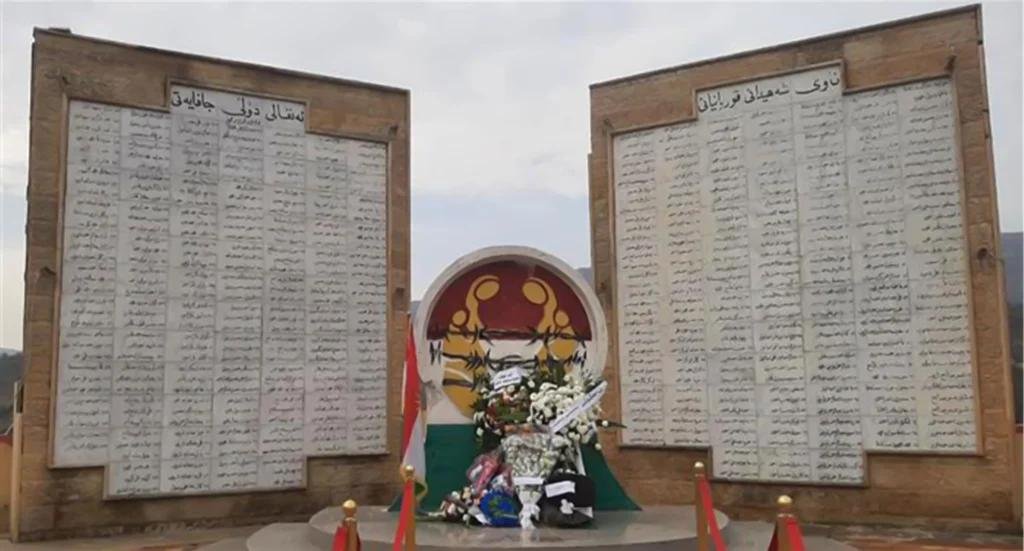
In 2010, the Anfal Monument of Doly Jafayati was constructed at the burial site in Dukan. The names of 482 Anfal victims were inscribed on the memorial wall as a lasting testament to their memory and to the crimes committed during the Anfal Genocide.
Sources
-
- Official documents of the collapsed Ba‘ath regime.
-
- MEW, The Genocide in Iraq and the Anfal Campaign against the Kurds.
-
- Documents of the Political Bureau of the Kurdistan Democratic Party.
-
- Field investigations and research (follow-up and interviews).
-
- Magazines and newspapers of the Ba‘ath era.
Remark on terminology:
The terms used by the Ba‘ath regime in its documents — such as “(hireling/mercenary), (saboteur), “criminal,” and many other degrading labels — were applied to any Kurd (except the collaborators known as “Jash”), whether Peshmerga or civilian. In this text, these terms are quoted exactly as they appear in the original documents, to preserve the historical record and reveal the dehumanizing language used by the regime as part of its genocidal policy.
Leave feedback about this