


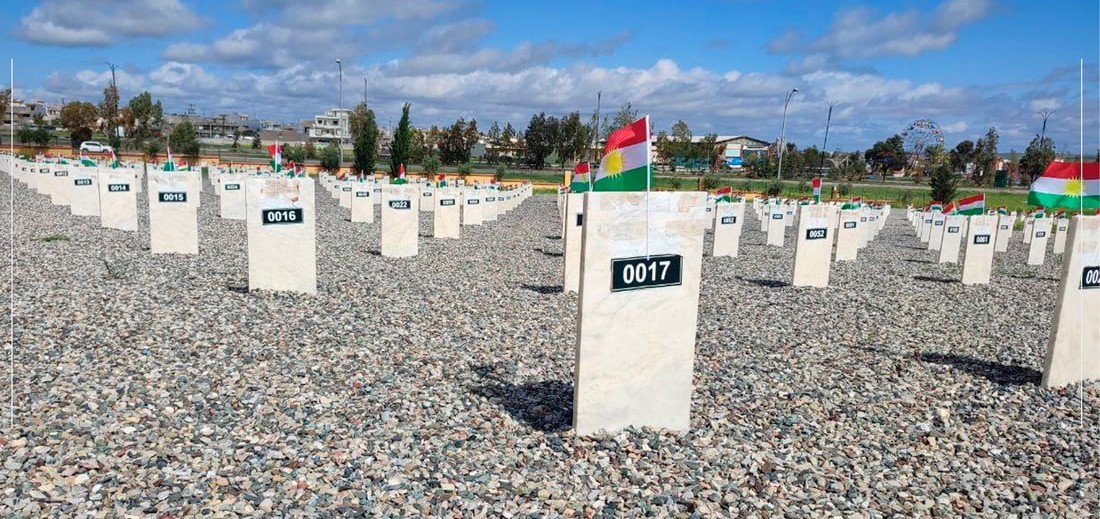
The Second Anfal 1988
The Second Phase of the Anfal Genocide (22 Mar–1 Apr 1988)
The Second Phase of the Anfal Genocide targeted the Qaradagh region from 22 March to 1 April 1988. According to Ba‘ath regime documents and official reports, the First and Second Anfal operations received extensive media coverage at the time and were portrayed as major “victories.”
The Ba‘ath newspaper Al-Thawra (issue no. 6522, dated 3 April 1988) published an article entitled “In the Second Anfal Operation, the Qaradagh Area Was Cleansed of Traitors.” Another report in the same issue declared that “The people of Erbil, Duhok, and Sulaymaniyah send greetings to the heroes of the Anfal Operation.” These statements were issued by Saddam’s collaborators (the Jash).
Only three days after the end of the First Anfal, Iraqi forces launched a new large-scale offensive. The operation was led by Lieutenant General Iyad Khalil Zaki (Fifth Army Corps) and Lieutenant General Kamil Sajit (Second Army Corps), under the direct supervision of General Adnan Khairallah (Minister of Defense) and Ali Hassan al-Majid, head of the Northern Bureau of the Ba‘ath Party.
Other senior officers involved included General Nizar Abdul-Karim al-Khazraji, Deputy Chief of Staff for Operations; General Hussein Rashid al-Tikriti, Director of Operations; Colonel Zahir Yunis Ali, commander of the 50th Division; and Colonel Saad Shams al-Din, commander of the National Defense brigades in the Sulaymaniyah and Qaradagh sectors.
This phase constituted a large-scale military campaign, broader in scope than the First Anfal, targeting the mountain chain of Qopi Qaradagh and imposing a siege on its mountainous terrain. From the beginning of the Iran–Iraq War until the onset of the Anfal Genocide in 1988, the regime had already carried out two major genocidal campaigns against the Kurdish people — the genocide of the Fayli Kurds in 1980 and the Barzanis in 1983. In addition, it committed hundreds of other crimes against humanity, including the forced depopulation of villages, mass displacement, the establishment of prohibited and restricted zones, and the execution of civilians. At the very outset of the Anfal campaign, the Iraqi regime carried out the chemical bombardment of Halabja, one of the most devastating attacks against Kurdish civilians.
Iraqi intelligence gathered detailed information about Peshmerga bases in Qaradagh, claiming that they provided logistical support to Iranian forces. The area had already been depopulated in 1987, when residents were forcibly relocated to the Nasr and Zarayan complexes, leaving only army units and local collaborators (Jash). Peshmerga forces later regained control of the area.In February 1988, eight Iraqi aircraft carried out a chemical attack on the villages of Sertakay and Balajwar. Witnesses described the attack as follows:
“The planes dropped numerous bombs — perhaps eight or nine. As they fell, they produced a sharp whistling sound, followed by explosions that released a faint gas cloud. Those exposed to the gas developed blisters on their skin, while animals that grazed on contaminated grass collapsed and died almost instantly. Fortunately, no civilians were killed, as residents had already taken shelter.
According to regime intelligence reports, Iraqi security services alleged that the so-called ‘treacherous group (Hask)’ had received nearly 1,500 gas canisters from the Iranian army. These exaggerated claims were later used as a pretext to justify the escalation of chemical and military operations during the Anfal campaign in Qaradagh.”
The Chemical Bombardment of the Village of Sewsênan
The village of Sewsênan, located in the eastern foothills of Qaradagh, was among the areas most severely affected by the chemical attacks carried out on 22 March 1988, during the Second Phase of the Anfal Genocide.
According to eyewitness accounts, intense bombardment began shortly after evening prayers on the night of 22–23 March, around sunset. One survivor described the scene:
“I was standing outside my house, facing the village, when I saw waves of fire descending upon Sewsênan. The bombardment came from the direction of Darbandikhan, with shells falling in clusters across the village. Out of approximately 350 households — around 1,500 inhabitants — more than 80 people were killed.”
On the following day (23 March), the nearby village of Dukan was also subjected to chemical bombardment. The regime continued its heavy and systematic attacks across the Qaradagh region, followed by ground assaults later that afternoon, when Iraqi forces advanced and occupied the area.
Those who attempted to escape were divided into two groups. One group fled northward toward Sulaymaniyah through rugged mountain paths; they eventually reached safety, although many lost their homes and possessions to looting. The second group fled southward toward Germian, where they were later captured, detained, and forcibly disappeared during the Anfal operations.
A report issued by the Political Bureau of the Kurdistan Democratic Party documented the names of 66 victims, aged between 1 and 59 years, all from villages in the Qaradagh region. They were killed in the chemical attacks of 28–29 March 1988, many of them women, children, and elderly civilians.
Iraqi army forces subsequently encircled the Qaradagh region. Villagers were separated: some fled toward Mount Glazerd and then to Sulaymaniyah, while others were deceived by army officers who promised that they would be taken to “safe camps.” These individuals were transported in military trucks and buses to the Toubzawa military camp near Kirkuk, where many were executed or buried in mass graves. The remaining population — exhausted, injured, and ill — moved toward Sangaw and Germian, with many dying along the way.
On 1 April 1988, the General Command of the Iraqi Armed Forces issued Communiqué No. 3109, declaring the “complete cleansing of the Qaradagh region from traitors” and the destruction of Peshmerga bases in Taki, Balagjar, Miuli, Bani Murad, Chircha Qala, Homar Qala, Balakan, Daband Faqira, Qaradagh, Oqla, Jafaran, Boxin, Sewsênan, Zarda, Kalosh, Berkê, Klaw Jom‘a, Bakhshê, Darband Basara, Sargarma, Qopi Qaradagh, and Achdakh.
Ba‘ath regime documents later revealed that, on 15 April 1988, a secret order (No. 169) issued by the Second Infantry Division “Khalid Bin Walid,” commanded by Colonel Adnan Naji, requested logistical support — including eight helicopters and twenty transport vehicles — to transfer the 39th Brigade from Piramagrun to Qaradagh, with air defense coverage for the operation scheduled for 20 April 1988.
A follow-up correspondence from the Ministry of Defense (Military Security Directorate, Document No. 48, dated 21 April 1988) confirmed this transfer and called for the establishment of a special security committee to oversee the operation, to be completed within 20 hours. These documents clearly demonstrate the systematic coordination and planning behind the Anfal Genocide operations in the Qaradagh region.
According to another document issued by the First Army Corps, under the command of Sultan Hashim, and sent to the General Command of the Armed Forces as a secret and urgent letter (No. 142, dated 20 April 1988), the following was reported:
“During the cleansing operations in the Qaradagh area, 2,500 detainees and ‘hirelings’ (men and women) were arrested, along with the seizure of weapons and ammunition in the Qopi Qaradagh area, including:
– 10 DShK (12.7 mm) heavy machine guns with 200 rounds of ammunition
– 200 Kalashnikov rifles
– 1,000 ‘romana’ (ammunition units)These detainees, along with the weapons and ammunition, have been placed in the custody of the Corps headquarters. We await your instructions in this regard. End.”
In response, the General Command of the Armed Forces issued letter No. 2/م خ, dated 23 April 1988, to the command of the First Army Corps, stating:
“With reference to your secret and urgent letter No. 142 dated 20/4/1988 regarding the 2,500 detainees and hirelings, they shall be distributed as follows:
– Men are to be transferred to the Command of the Fourth Army Corps
– Women are to be transferred to the Command of the Third Army Corps
– Children are to be transferred to the Zerpyosh military camp in TikritThey shall be transported together with our representative using special vehicles. End.”
These documents constitute some of the clearest evidence demonstrating how the Ba‘ath regime systematically arrested, separated, and forcibly disappeared Kurdish civilians — men, women, and children — during the Anfal Genocide.
Sources
- Official documents of the collapsed Ba‘ath regime.
- MEW, The Genocide in Iraq and the Anfal Campaign against the Kurds.
- Documents of the Political Bureau of the Kurdistan Democratic Party.
- Field investigations and research (follow-up and interviews).
- Magazines and newspapers of the Ba‘ath era.
* Note on Sultan Hashim:
Lieutenant General Sultan Hashim Ahmad Muhammad al-Tai served in the Fourth Division as commander of the 5th Infantry Brigade, then as commander of the Fourth Division, later as commander of the Fifth Army Corps, and finally as commander of the First Army Corps during the Iran–Iraq war (1980–1988). He was one of the principal military leaders in charge of the Anfal operations.
Remark on terminology:
The terms used by the Ba‘ath regime in its documents — such as “bakrigraw (hireling/mercenary), têkder (saboteur), “criminal,” and many other degrading labels — were applied to any Kurd (except the collaborators known as “Jash”), whether Peshmerga or civilian. In this text, these terms are quoted exactly as they appear in the original documents, to preserve the historical record and reveal the dehumanizing language used by the regime as part of its genocidal policy.
Leave feedback about this