


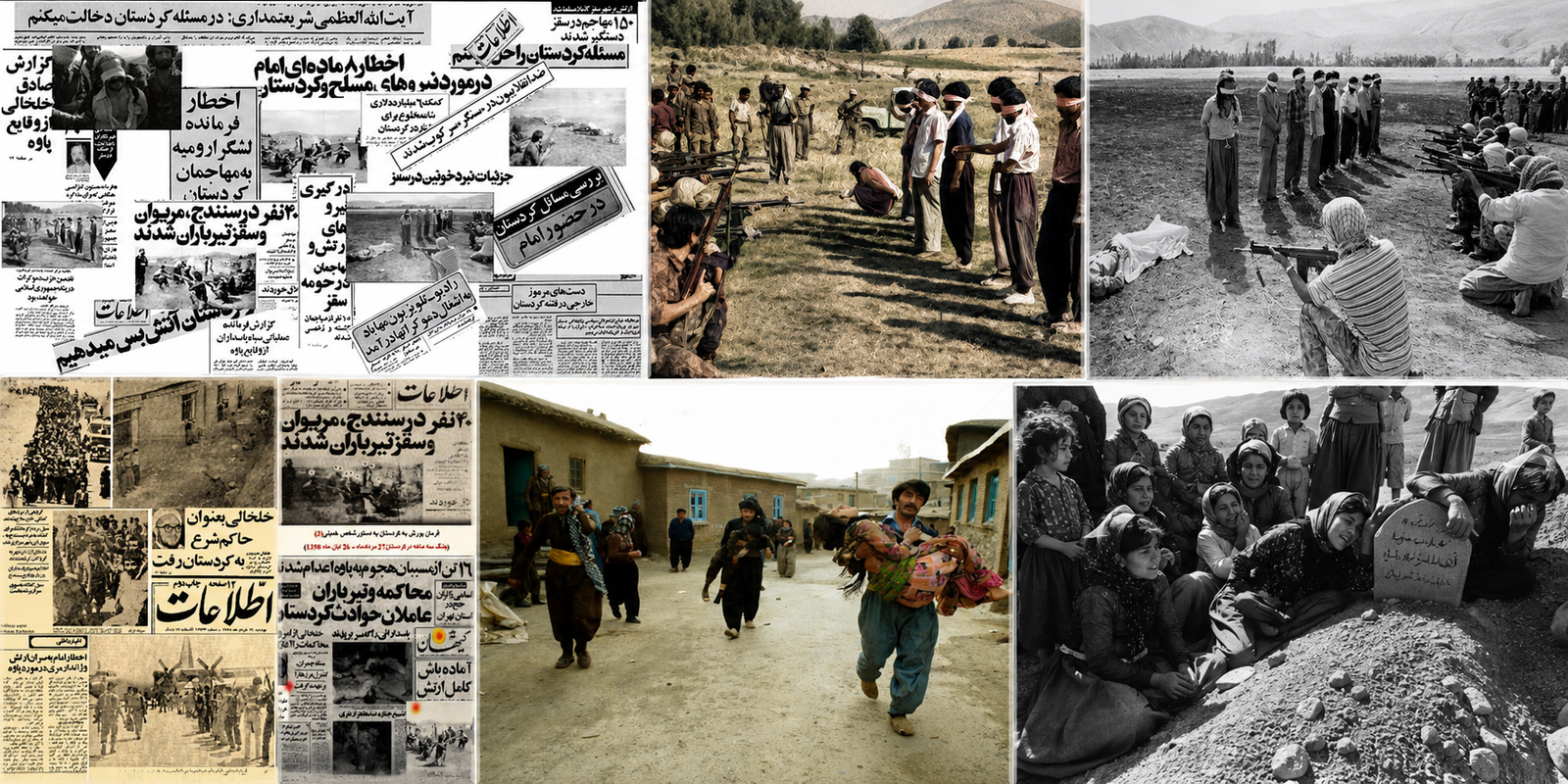
Massacres in Eastern Kurdistan
A Unified Scientific Study Based on Available Information
1979–1987
Introduction
After the 1979 Iranian Revolution and the fall of the monarchy, Eastern Kurdistan became one of the main regions subjected to military, political, and security repression by the Islamic Republic of Iran. Between 1979 and 1987, a large number of cities, villages, and areas of Eastern Kurdistan were targeted by bombardment, ground attacks, mass arrests, executions, shootings, burning, and the destruction of villages.
According to various sources and available information, the figures concerning victims, destroyed villages, and targeted locations differ. This discrepancy is due to the absence of an official and independent investigation, the lack of a unified archive, restricted access to documents, and the fact that part of the information has been preserved through eyewitnesses, political reports, local media, and the memoirs of victims.
For this reason, this study presents the figures scientifically and cautiously, treating them as minimum estimates. Based on the information currently available, it can be stated that:
Between 1979 and 1987, widespread massacres and repression occurred in at least 11 cities and areas, and in 61 villages and locations in Eastern Kurdistan, resulting in the martyrdom of thousands of people, as detailed in the body of the study. Furthermore, according to different sources, between 51 and 64 villages were burned, destroyed, or severely damaged.
1. Political and Historical Background
After the fall of the monarchy in Iran, the Iranian people in general, and the Kurdish people in particular, expected a new phase of democracy, political freedom, national rights, and equal participation. However, the policy of the Islamic Republic of Iran toward Kurdistan soon shifted from dialogue and political resolution to military and security repression.
On 18 August 1979, following the decree issued by Khomeini, the leader of the Islamic Republic of Iran, to suppress Kurdistan, a new and more violent phase of the regime’s attacks began. This decree, referred to in Persian documents as “The Imam’s Eight-Article Authorization Regarding the Armed Forces and the Suppression of Kurdistan” (اختیار ۸ مادهای امام در مورد نیروهای مسلح و سرکوب کردستان), effectively granted broad powers to the armed forces to carry out repression, attacks, arrests, and the use of violent force against Kurdistan.
Following this phase, the forces of the Islamic Republic of Iran systematically began attacking the cities and villages of Eastern Kurdistan. This policy was not merely military in nature; it also had political and social objectives: to break the Kurdish political movement, terrorize the civilian population, destroy society’s capacity for resistance, and force people into silence or displacement.
2. Methods of Repression and Massacre
According to the available information, the policy of the Islamic Republic of Iran in Eastern Kurdistan included several main methods:
First: Aerial and Ground Attacks on Cities
Cities such as Sanandaj, Mahabad, Shno, Piranshahr, Saqqez, and Mariwan were targeted in different ways through bombardment, military assault, and the militarization of the region.
Second: Mass Arrests and Detentions
Thousands of people were arrested during the early years of the Islamic Republic. Some were sentenced in rapid and unjust trials, some were executed, and others died under torture in prisons.
Third: Shootings and Mass Executions
In some cities and areas, such as Mahabad, large numbers of young people and civilians were killed by hanging or by shooting.
Fourth: Attacks on Villages
Villages became one of the regime’s main targets. In many places, civilians — women, men, the elderly, and children — were victimized in attacks and massacres without distinction.
Fifth: Burning and Destruction of Villages
According to the sources, the number of destroyed or burned villages varies. Some sources cite 51 villages, while others cite 64. In a scientific study, this discrepancy can be recorded as a “variation among sources.” However, the more reliable basis is to state that at least 51 villages were destroyed or burned, and according to various sources, this number reaches 64 villages.
3. Examples of Targeted Cities and Villages
Sanandaj
Sanandaj was one of the first cities in Eastern Kurdistan to become a target of regime attacks after the 1979 Revolution. On 18 March 1979, two days before Newroz and only 35 days after the victory of the Iranian Revolution, regime forces attacked Sanandaj by land and air. This attack resulted in the killing of hundreds of civilians. Abdullah Hassan-Zadeh gives the number of victims as 450, while Ghani Blourian refers to 2,300 victims.
On 19 March 1979, after Khomeini issued a jihad fatwa, regime forces repeatedly attacked the city from the air and by land. According to some information, nearly 600 people were killed as a result of these attacks.
Qarne
The village of Qarne, belonging to the Naqadeh area, is one of the most prominent examples of massacre in Eastern Kurdistan. On 2 September 1979, forces of the Islamic Republic of Iran attacked this village and killed 68 people, of whom the names of 60 have been confirmed. Among the victims were children, elderly men, and civilians. This event became one of the main indicators of systematic violence against Kurdish villages.
Mahabad
Mahabad was also one of the important centers of repression. On 2 June 1983, the Iranian regime executed more than 59 young people from Mahabad by hanging; some of them were under the age of 18. This event demonstrated the use of executions and rapid, unjust trials as instruments of intimidation and repression.
Urmia and the Surrounding Villages
The areas surrounding Urmia, especially Anzal and Soma, were targeted by several attacks between 1983 and 1987. Villages such as Gicha, Piranjokh, Mirawa, Kureh Zhuru, Kureh Khowaru, Qojokh, Karez, Roola, and Golank are among the places where human casualties and damage were recorded.
Hawshar
The Hawshar region is one of the areas where a large number of villages were subjected to attacks, arrests, killings, and executions. The villages of Nabikandi, Lower Ahmadawa, Shermard, Qazqapan, Middle Aghdarah, Hassanawa, Hassan Lawan, Yaraziz, Cheragh Tappeh, Mainbalakh, Gweghaj, Qazqopi, Khatunawa, Dashkastan, Dumeskani, Agajari, Seinjut, and Qozlu are among the places whose names repeatedly appear in the available information.
4. Targeted Cities
According to the information currently available, between 1979 and 1987, the following cities and areas were subjected to repression, bombardment, mass arrests, executions, or shootings:
- Sanandaj
- Naqadeh
- Urmia
- Mahabad
- Oshnavieh / Shno
- Piranshahr
- Bukan
- Khoy
- Maku
- Saqqez
- Marivan
These cities were not targeted in the same manner. Some were bombarded; in others, mass executions and shootings took place; while in others, arrests, intimidation, militarization, and political cleansing were carried out.
5. Targeted Villages, Areas, and Sites, and the Record of Incidents
According to the available information, the massacres in Eastern Kurdistan were not confined to cities alone; rather, they also widely affected villages and areas surrounding the cities. These places became targets of attacks, arrests, torture, executions, shootings, burning, and destruction. In order to move the case from a general level to an evidentiary level, the record of these locations is presented here according to area, date, number of victims, and the methods of crimes committed.
Sana
Sana
On 18 March 1979, two days before Newroz and only 35 days after the victory of the Iranian Revolution, regime forces attacked Sanandaj by land and air. This attack resulted in the killing of hundreds of civilians. Abdullah Hassan-Zadeh gives the number of victims as 450, while Ghani Blourian refers to 2,300 victims.
On 19 March 1979, after Khomeini issued the jihad fatwa, regime forces repeatedly attacked the city from the air and by land. According to some information, nearly 600 people were killed as a result of these attacks.
Niar
Located near the city of Sanandaj. On 28 May 1983, one person was killed.
Naqadeh
Qarne
The village of Qarne, belonging to the Naqadeh area, is one of the most prominent examples of massacre in Eastern Kurdistan. On 2 September 1979, forces of the Islamic Republic of Iran attacked this village and killed 68 people, of whom the names of 60 have been confirmed. Among the victims were children, elderly men, and civilians. This event became one of the main indicators of systematic violence against Kurdish villages.
Qalatan
A village near the city of Naqadeh. On 26 March 1980, more than 12 people were massacred there.
Bayzawa
Located near Naqadeh. On 8 December 1981, nine people were killed.
Bapirawa
Located near Naqadeh. On 9 December 1981, nine people were killed.
Dilancharkh, Halbe, Koykan, Karizay Shikakan, and Yunslian
Located near Naqadeh. On 14 March 1983, 40 people were killed, but the identities of only 23 people have been confirmed.
Khalifan and Gorkhana
Located near Naqadeh. On 25 March 1983, eight people were killed in these villages.
Cheqal Mustafa
Located near Naqadeh. On 25 March 1983, 16 people were killed, while the names of only 13 of them are available.
Kani Ard
Located near Naqadeh. In 1984, one person was killed.
Urmia
Sinawa
Located near Urmia. On 18 March 1985, nine people were killed.
Gacha
Located near Urmia. On 23 March 1983, 13 people were killed, and all their names have been confirmed. Regime forces also arrested 35 other people and subjected them to brutal torture in prison. One of the prisoners, Shakur Ahmadi, the brother of Ibrahim Ahmadi, who had previously been martyred, lost consciousness under severe torture. In addition, during the aerial bombardment, a woman named Rahima Rohani was killed, and several others were wounded.
Piranj
Located near Urmia. On 27 March 1983, 17 people were killed.
Mirawa
Located near the Soma area of Urmia. On 2 April 1983, 11 people were killed, including six children. These children were killed while they were with their mothers. Among those killed was a woman named Rafiya, daughter of Shakir, who was 70 years old. Also killed were a woman named Maryam Mustafazadeh, a woman named Hanifa Khadri together with her child, and another woman named Farida Mohammadi together with her two children.
Kureh Zhuru
Located near the Anzal area of Urmia. On 13 April 1983, five people were killed.
Kureh Khowaru
Located near the Anzal area of Urmia. On 13 April 1983, ten people were killed; among them were four people from the village of Hamama, one person from Mamakan, and one person from Mingol.
Qojokh
Located near the Anzal area of Urmia. On 19 August 1983, two women named Naza Ahmadi and Gula Ahmad were killed.
Kariz
Located near Anzal in Urmia. In the years 1983, 1984, and 1991, a total of three people were killed. This site requires a separate note, because the year 1991 falls outside the main framework of 1979–1987; however, for the purpose of completing the record of information, it may be recorded as a continuation of the same policy of repression.
Roola
Located near Urmia. On 1 January 1987, seven people were killed; the names of six of them have been confirmed.
Golank
Located in the Anzal area, near Urmia. In 1983, eight people were killed.
Mahabad
Inarqash and Wusukand
Located near Mahabad. On 4 November 1980, 53 people were killed, of whom the names of 35 have been confirmed. According to the information, the Basij forces of the Islamic Republic of Iran carried out this attack under the leadership of a person named Maaboudi.
Qaragol
Located near Mahabad. On 26 January 1983, 18 people were killed. Some of them were 70 years old or older.
Sawzi
Located near Mahabad. On 26 January 1983, nine people were killed.
Mahabad
On 2 June 1983, the Iranian regime executed more than 59 young people from Mahabad by hanging; some of them were under the age of 18.
Dama Sur, Jafarawa, and Marzhanawa
Located near Mahabad. On 3 March 1983, a large number of people were killed in these villages, but the names of only nine people have been confirmed.
Jafarawa
Located near Mahabad. On 16 March 1983, two people were killed.
Shno / Oshnavieh
Sofia
Located near the city of Shno. On 18 November 1980, 12 people were killed. Among them, seven people were over the age of 50. In addition, 20 other people were wounded in this attack.
Jibrailawa, Gundewela, and Duawa
Located near the city of Shno. On 14 September 1983, six people were killed in these villages.
Khoy
Kotol and Habash
Located near the city of Khoy. On 9 April 1979, 20 people were killed in these areas.
Maku
Yarmq
Located near Maku. On 4 May 1981, a man named Ismail Ramini, son of Mohammed, was killed. On 5 November 1981, two other men were killed. Ibrahim Hemati, son of Ali, was another victim who was killed in 1983.
Kharman
Located near Maku. On 2 June 1981, one person was killed.
Timka
Located near Maku. On 5 November 1981, one person was killed.
Bukan
The Saruqamish Brick Factory
Located near Bukan. On 13 September 1981, 18 people were killed, of whom the names of 13 have been confirmed.
Hawshar
Nabikandi
Located near Hawshar. In 1980, regime forces killed nine people.
Lower Ahmadawa
Located near Hawshar. In 1980, six people were killed, one of whom was 11 years old.
Shermard
Located near Hawshar. In 1980, two people were killed.
Qazqapan
Located near Hawshar. In 1980, one person was killed.
Middle Aghdarah
Located near Hawshar. In 1980, one person was killed.
Hassanawa
Located near Hawshar. In 1980, one person was killed.
Hassan Lawan
Located near Hawshar. In 1980, two men, a father and son, were killed.
Yaraziz and Cheragh Tappeh
Located near Hawshar. In 1980, four women were killed.
Mainbalagh
Located near Hawshar. On the night of 3 September 1981, regime forces arrested 11 people and later hanged them.
Gwe Aghaj
Located near Hawshar. In 1981, Iranian regime forces killed five people there.
Qazqopi
Located near Hawshar. In 1981, two people were killed.
Khatunawa
Located near Hawshar. In 1981, one person was killed.
Dashkastan
Located near Hawshar. In 1981, three people were killed.
Dumeskani
Located near Hawshar. In 1981, three people were killed.
Aghajari
Located near Hawshar. In 1982, an elderly man and his wife were killed. They had believed that, because of their old age, the forces would not kill them, and therefore they had not fled the village. However, the armed forces of the Islamic Republic of Iran killed them.
Seinjut
Located near Hawshar. In 1982, four people were killed.
Qozlu
Located near Hawshar. In 1982, two people were killed. A large number of other people were also arrested, and later two of them were hanged.
6. Figures and the Limits of Available Information
In scientific research, discrepancies in figures should not be regarded as a weakness of the subject; rather, they should be understood as evidence of the need for further archival, legal, and field-based research. In cases involving massacres and state repression, especially when the state itself is the accused party, official figures, eyewitness accounts, figures provided by political organizations, and internal archival records often differ.
Therefore, this study standardizes the figures as follows:
Period of the incidents: 1979–1987
Targeted cities and areas: at least 11 cities and areas
Villages and sites of massacre: at least 61 villages and areas
Victims verified according to available information: at least 518 people
Burned or destroyed villages: according to the sources, between 51 and 64 villages
These figures should not be regarded as final or complete. Rather, they should be recorded as an initial foundation for a larger and more fully documented investigation.
7. Legal and Historical Assessment
From a legal perspective, the events that took place in Eastern Kurdistan between 1979 and 1987 require careful assessment within the framework of several international legal concepts:
Massacre
The mass killing of civilians, especially in villages, can be recorded as massacre.
Crimes Against Humanity
If the attacks were carried out in a widespread or systematic manner against the civilian population, they may be assessed within the framework of crimes against humanity.
Genocide
For legal and international recognition as genocide, precise evidence must be collected regarding the intent to destroy, in whole or in part, a national, ethnic, racial, or religious group. In this case, what requires further investigation includes: political and military orders, the regime’s official language, the methods of attack, the selection of targets, and the testimonies of victims and survivors.
Accordingly, at the historical and political level, these events may be recognized as massacres and systematic cleansing against the Kurdish people in Eastern Kurdistan. At the level of international law, however, the case must be supported by further evidence, testimonies, written orders, and judicial archives.
8. The Importance of Documentation and Justice
Although these tragedies were widely reported at the time in local and regional media, they have not yet become the subject of a major, independent, and official investigation at the political, legal, and international levels. As a result, many victims, names, locations, orders, and testimonies have still not been fully incorporated into an official historical archive.
Therefore, it is necessary to:
Collect and verify the names of all victims.
Document the sites of attacks, destroyed villages, and the graves of victims.
Record the testimonies of survivors and victims’ families.
Collect political, military, and judicial documents.
Present the case within the frameworks of justice, history, human rights, and international law.
Conclusion
The massacres in Eastern Kurdistan between 1979 and 1987 constitute part of the painful and bloody history of the repression of the Kurdish people in the twentieth century. These events were not merely a series of military attacks; rather, they formed part of a broader policy aimed at breaking the political and national will of the Kurdish people, intimidating society, destroying civilian areas, and erasing the memory of resistance.
According to the information currently available, these massacres and acts of widespread repression occurred in at least 11 cities and areas and 61 villages and locations in Eastern Kurdistan between 1979 and 1987. They resulted in the martyrdom of thousands of people, as detailed in the body of this study. Furthermore, according to various sources, between 51 and 64 villages were burned, destroyed, or severely damaged.
This case still requires scientific, archival, legal, and international work. Documenting these events is not only about preserving the past; it is also about recognizing the truth, honoring the victims, seeking justice for their families, and preventing the recurrence of such crimes.
Sources
- KGNA Field Investigation.
- Abdullah Hassan-Zadeh, writings and accounts on the events of Sanandaj, 1979.
- Ghani Blourian, memoirs and accounts on the events of Sanandaj, 1979.
- Abdorrahman Boroumand Center, “The Qarna Massacre.”
- Hengaw Organization for Human Rights, “The Kurdish Massacre of 1979 in Iran.”
- Iran International, “Iranian Kurds Commemorate 1980s Mass Execution of 59 Youths,” 2023.
- HANA Human Rights Organization, “On the Anniversary of the Execution of 59 Prisoners from Mahabad.”
- IranWire, reports and references on the 1983 Mahabad executions.
- MERIP, “The Kurds Between Iran and Iraq,” 1986.
- David McDowall, A Modern History of the Kurds.
- United Nations, Convention on the Prevention and Punishment of the Crime of Genocide, 1948.
- International Criminal Court, Rome Statute, Article 7: Crimes Against Humanity.
Scientific Note
For figures that differ across sources, it is preferable to state in the text:
“According to different sources, the figures vary; therefore, this study records the minimum figures as a scientific and cautious basis.”
Leave feedback about this