


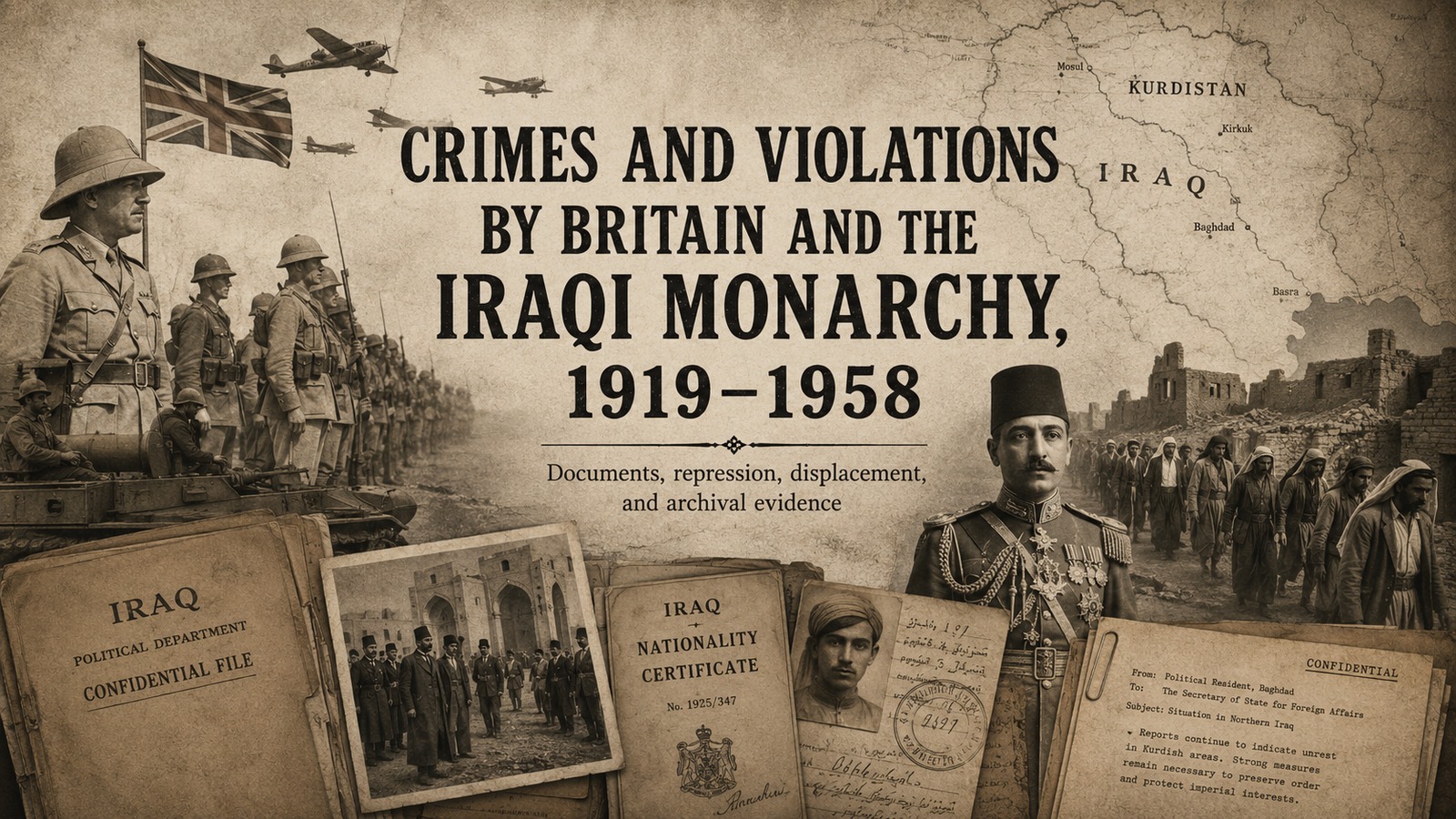
Introduction
To understand the history of crimes, repression, and human-rights violations in Iraq during the first half of the twentieth century, it is necessary to begin with the political and geographical transformations that followed the First World War. The collapse of the Ottoman Empire enabled the victorious powers, particularly Britain and France, to reshape the political map of the Middle East in line with their strategic, political, and economic interests.
This reorganisation was not the outcome of a single treaty. It developed through a series of agreements, conferences, treaties, and international decisions, including the Sykes–Picot Agreement, the San Remo Conference, the Treaty of Sèvres, the Treaty of Lausanne, the League of Nations’ decisions concerning the Mosul Vilayet, and the Treaty of Ankara.
Kurdistan had already been divided between the Ottoman Empire and Iran before the First World War. However, the creation of new states and borders after the war deepened and formalised the division of Kurdistan. Kurdish-populated territories were incorporated into several different states without a just settlement of the Kurdish people’s national rights, self-government, or right to self-determination.
Articles 62–64 of the 1920 Treaty of Sèvres proposed a limited framework for autonomy in certain Kurdish regions and the possibility of future independence. The treaty, however, was never implemented. The 1923 Treaty of Lausanne replaced Sèvres but contained no specific recognition of Kurdistan, Kurdish national rights, or the Kurdish right to self-determination.
It would therefore be historically more accurate not to claim that the Treaty of Lausanne alone divided Kurdistan. Rather, Lausanne was one of the major stages in consolidating a new regional border system which, together with the agreements and international decisions that preceded and followed it, formalised and reinforced the division of Kurdistan.
Within this new regional order, Britain consolidated its political and military authority over Mesopotamia. Iraq was placed under the British Mandate, and the monarchy was established in 1921 with the accession of Faisal I as King of Iraq.
Although Iraqi state institutions were formally created, Britain maintained extensive influence over defence, foreign policy, military planning, the air force, strategic communications, and the future of the Mosul Vilayet. British political and military influence remained a central feature of the formation and administration of the new Iraqi state.
During this period, military and air power were employed to consolidate the new political order and suppress national movements and local opposition. The policy known as air control enabled Britain to exercise authority over large areas of Iraq and Kurdistan through aerial bombardment, punitive raids, village destruction, attacks on sources of livelihood, and the continuing threat of force.
After the establishment of the Iraqi monarchy, responsibility for crimes and violations was not limited to one authority. Some operations were directly planned and carried out by Britain. Others were implemented by the Iraqi monarchical government and its military, security, and administrative institutions. In several cases, Britain and the Iraqi government were both involved through military planning, command, advice, logistical support, weapons, aircraft, or joint operations.
This research therefore examines crimes and violations committed between 1919 and 1958 within one historical framework, while avoiding the conflation of responsibility. Each event will be examined based on available documents, official orders, military and administrative records, political reports, newspapers, testimonies, and oral history, to determine the role of Britain, the Iraqi monarchy, or both.
Research Problem
The main problem addressed by this research is that the history of crimes and repression between 1919 and 1958 has often been recorded in a fragmented manner.
Some sources focus mainly on Britain’s role, while others attribute responsibility exclusively to the Iraqi monarchical government. Such approaches frequently fail to examine the relationship between British occupation, the Mandate system, the establishment of the Iraqi state, and the continuation of British political and military influence.
Many violent events were also recorded in official archives under administrative or military expressions such as:
- military operation;
- pacification of a region;
- suppression of rebellion;
- restoration of security;
- establishment of governmental authority.
Such official terminology may conceal or minimise civilian casualties, village destruction, forced displacement, collective punishment, confiscation of property, and other forms of abuse.
Another major difficulty is the absence of complete records concerning the names and numbers of those killed, wounded, detained, deported, or forcibly displaced. The absence of complete statistics in official records must not be interpreted as evidence that no crimes or human losses occurred.
Main Research Questions
This research seeks to answer the following questions:
- How did British political and strategic interests influence the establishment and administration of the Iraqi monarchy?
- In which events and regions were British land and air forces used?
- Which crimes and violations were committed directly by Britain?
- Which events were the responsibility of the Iraqi monarchical government and its institutions?
- In which cases was responsibility shared between Britain and the Iraqi government?
- What consequences did these policies and military operations have for the Kurds, Kurdistan, and other communities in Iraq?
- How were laws and administrative decisions used to impose discrimination, deprive people of nationality, confiscate property, restrict civil rights, and carry out deportation?
- How did military repression, legal discrimination, and administrative exclusion develop into long-term state policies?
Objectives of the Research
The principal objective of this research is to collect, organise, analyse, and document information concerning crimes and violations committed between 1919 and 1958.
Its specific objectives are:
- to explain the political and historical background of each event;
- to distinguish Britain’s responsibility from that of the Iraqi monarchical government;
- to identify cases of shared responsibility;
- to document human, material, social, and cultural losses;
- to preserve the memory of victims and affected communities;
- to collect official documents, photographs, maps, newspapers, testimonies, and local records;
- to examine the use of military, legal, and administrative mechanisms of repression;
- to establish a scholarly and archival foundation for future research;
- to make relevant materials accessible through the Kurdistan Genocide National Archive.
Temporal and Geographical Scope
The temporal scope of the research begins in 1919, the year of Sheikh Mahmud Hafid’s first uprising against British authority, and continues until 14 July 1958, when the monarchical system in Iraq was overthrown.
The geographical scope primarily covers Iraq and Southern Kurdistan, with particular attention to areas subjected to:
- aerial bombardment;
- military operations;
- political repression;
- village destruction;
- detention;
- deportation;
- forced displacement;
- discriminatory nationality policies;
- confiscation of property;
- restrictions on national, religious, and civil rights.
Where necessary, the study will also examine regional and international developments that directly affected Kurdistan and Iraq, particularly the Mosul Question, British–Turkish negotiations, and the formation of the post-war border system.
Research Methodology
This research adopts historical, descriptive, comparative, and analytical methods.
The study is based on several categories of sources:
- British and Iraqi official documents;
- military and security orders and reports;
- Royal Air Force operational records;
- British political and diplomatic correspondence;
- Iraqi government and Ministry of Interior records;
- nationality and civil-status records;
- international treaties and decisions;
- contemporary newspapers and periodicals;
- scholarly books and academic research;
- maps, photographs, and lists of names;
- oral-history interviews;
- testimonies of survivors and victims’ families;
- local and family archives.
Sources will be compared with one another, and every claim will be evaluated according to the strength and reliability of the available evidence.
Where sources disagree on dates, numbers, names, or the scale of losses, those differences will be clearly stated. Information that has not been fully verified will not be presented as a final fact.
Official terminology will also be examined critically. Terms such as “rebellion,” “pacification,” “punitive action,” and “restoration of order” will be compared with evidence concerning civilian casualties, displacement, bombardment, property destruction, and collective punishment.
Framework for Classifying Responsibility
To prevent the conflation of responsibility, the events examined in this research are divided into three principal categories.
1. Direct Crimes and Violations by Britain
This category includes events in which Britain played the principal role in planning, command, or implementation, or in which British military and air forces were directly involved.
It includes actions carried out during the period of occupation and the British Mandate, particularly military repression, aerial bombardment, punitive raids, village destruction, and operations conducted by forces under British command.
2. Crimes and Violations by the Iraqi Monarchical Government
This category includes events in which decisions and implementation were primarily carried out by the Iraqi government, army, police, Ministry of Interior, nationality authorities, or other institutions of the monarchical state.
It covers military repression, administrative persecution, discriminatory laws and decisions, deprivation of nationality, deportation, confiscation of property, and restrictions on national and civil rights.
3. Joint Crimes and Violations
This category includes events in which Britain and the Iraqi government both played substantial roles.
Joint responsibility may be established where:
- Iraqi forces carried out ground operations;
- Britain supplied aircraft or aerial support;
- British officers or advisers participated in planning or command;
- British-controlled forces took part;
- weapons, transport, intelligence, or logistical support were provided by Britain;
- political decisions were made by the Iraqi authorities under British pressure or influence.
This classification is not absolute. If new evidence emerges, an event may be reclassified according to the documentary record.
Main Events and Violations Covered by the Research
The Period of British Occupation and Mandate
- 1919 — The suppression of Sheikh Mahmud Hafid’s first uprising against British authority
- 1920 — The British suppression of the Iraqi Revolt
- 1922–1924 — British military operations against the Government of Kurdistan and the movement led by Sheikh Mahmud Hafid
- 1923 — The British bombing and occupation of Rawanduz
- The use of air control, aerial bombardment, punitive raids, village destruction, and collective punishment in Iraq and Kurdistan
The Iraqi Monarchical Era
- 1930 — The suppression of the 6 September demonstration in front of the Sulaymaniyah Saray, known as “Black September”
- 1930–1931 — The suppression of Sheikh Mahmud Hafid’s final uprising
- 1931–1932 — The suppression of the First Barzan Uprising, led by Sheikh Ahmed Barzani
- 1933 — The genocide and massacres of the Assyrians in Simele and the surrounding areas
- 1935 — The military operation and massacre against the Yazidis in Sinjar
- 1936 — The first process of deporting the Faili Kurds, including expulsion and the revocation or denial of their nationality
- 1943–1945 — The suppression of the Second Barzan Uprising, led by Mustafa Barzani
- Discriminatory policies and decisions, forced displacement, property confiscation, deprivation of nationality, and restrictions on national and civil rights
General Sources
- The National Archives of the United Kingdom
- British Library – India Office Records
- Qatar Digital Library
- League of Nations Archives
- Royal Air Force historical records and studies
- Official records and laws of the Iraqi monarchical government
- Academic books and studies on Kurdistan, the British Mandate, and the Iraqi monarchy
Leave feedback about this