



The Genocide of the Fayli Kurds 1980
Historical and Identity Introduction
There are many theories regarding the origin of the name “Fayli Kurds,” and this issue has been debated in historical and linguistic studies. However, most researchers agree that the word “Fayli” derives from the root words “Pala,” “Palayi,” “Pahli,” or “Pahlavi,” which mean “hero” or “champion”. From a linguistic perspective, these terms underwent phonetic transformations due to language changes and Arabization, particularly because the Arabic language lacks the letter “P.” Consequently, these terms evolved into “Fahlawi,” “Fahla,” “Fahli,” and eventually “Faili.”
The Kelhor / Pahli / Pala Kurds are indigenous inhabitants of the southern Zagros region, who today are known as the Faili Kurds. In English, they are referred to as (Pehlí, Faili, or Fayli), in Arabic as (الفيليون أو الكراد الفيلية), and in Persian as (“فیلی”), derived from the root “Pahlavi” or “Fahlavi.” They constitute an inseparable part of the Kurdish nation and speak three Kurdish dialects: Ilami Kurdish, Laki, and Lori.
The use of the term “Faili Kurds” in this research, rather than “Pala” or “Pahlayi Kurds,” is because all Iraqi state documents across different historical periods refer to them as “Failis.” This does not imply assimilation, which refers to the erasure and removal of a nation’s identity, language, and authentic culture through deliberate cultural policies imposed by dominant authorities.
Historically, the roots of the Pahli (Faili) Kurds date back to the first millennium BCE, when they inhabited the Zagros region. Some historical studies indicate that this group had close connections with ancient civilizations such as the Elamites or the Gutians. Additionally, in Ilam province, there is a region called “Pahla,” which, according to some sources, is considered the origin of the name “Faili.”
From a religious perspective, the Faili Kurds are generally divided between followers of Shi’a Islam and followers of the Yarsan (Ahl-e-Haqq) faith. According to historical sources, a large portion of the Faili Kurds converted to Shi’a Islam during the Safavid Empire (1507–1721) in Persia.
Geographically, the Faili Kurds constitute one of the fundamental components of the Kurdish people, residing in both Iraq and Iran. In Iran, the Faili Kurds mainly live in the provinces of Lorestan, Kermanshah, and Ilam. In Iraq, they reside in the Kurdistan Region, as well as in the eastern Tigris areas, Baghdad, Diyala, Kut, Maysan, and the central and southern regions of Iraq. This geographical distribution demonstrates that the Faili Kurds are historically and socially an indigenous population of the region, with continuous historical presence.
The term “Faili” is also used to describe a group of Ilami Kurdish tribes who historically inhabited the areas of Pishkuh and Poshtkuh in the Zagros mountain range. Most historians and researchers agree that the Failis have ancestral connections with ancient Elamite or Gutian populations. Furthermore, in Ilam province, there is a region called “Pahla,” which, according to some studies, is considered the origin of the name “Faili.” This historical legacy demonstrates that the Faili Kurds have deep roots in the ancient history of the region.
Fayli Kurds in the Iraqi State
The situation of the Faili Kurds in Iraq dates back to the early establishment of the Iraqi state. In 1924, the Iraqi Nationality Law divided the population of Iraq on the basis of religion, ethnicity, and origin. As a result of this law, the majority of the Faili Kurds were registered as having Iranian nationality. This legal classification became the foundation for discrimination and oppression against them, and they were continuously treated as second-class citizens by successive Iraqi authorities.
Consequently, the Faili Kurds were consistently subjected to discriminatory policies and attacks by Iraqi authorities. From the monarchy period to the republican era, and until the fall of the Ba’ath regime, over several decades, they were repeatedly exposed to deportation, expulsion, forced displacement, mass killings, and ethnic cleansing.
Research studies categorize these policies into four main phases, beginning in 1936. However, the largest and most systematic phase of these crimes was the genocide of the Faili Kurds in 1980, carried out by the Iraqi Ba’ath regime in an organized and systematic manner.
Therefore, understanding the genocide of the Faili Kurds requires understanding this historical and legal background, as the crime was not a sudden event, but rather the result of long-term policies aimed at eliminating a specific national group.
Phases of Deportation and Genocide of the Faili Kurds in Iraq
The Monarchy Period
First Phase (1936)
In 1936, during the government of Yasin al-Hashimi, when Rashid Ali al-Gaylani served as Minister of Interior, the first phase of the deportation of the Faili Kurds took place. Many Faili Kurdish families were forcibly displaced and deported to Iran.
The Republican Period
Second Phase (1969)
In 1969, the Faili Kurds were subjected to another wave of deportation and expulsion. Approximately 200 families were forcibly displaced.
Third Phase (1971-1972)
Between 1971 and 1972, the deportation campaign expanded significantly. Approximately 40,000 Faili Kurds were forcibly expelled from Iraq under the pretext that they were of Iranian origin.
The Ba’ath Regime Period
Fourth Phase: The Genocide of the Fayli Kurds (1980–1990)
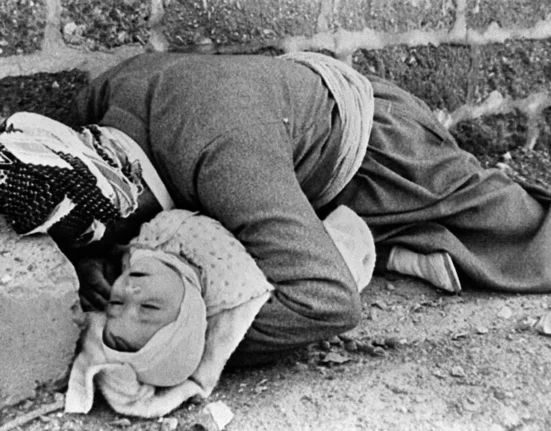
From April 4, 1980, to May 19, 1990, the Iraqi Ba’ath regime carried out a systematic genocide against the Faili Kurds. To legalize these crimes, the regime issued a series of decisions from the dissolved Revolutionary Command Council, along with thousands of official orders and directives to implement deportation, confiscation of property, and the enforced disappearance of thousands of young Faili Kurds.
This phase, carried out in a systematic and widespread manner, represented one of the largest crimes committed against the Kurdish people and one of the most striking examples of genocide in modern history.
The fallen Ba’ath regime sought to strengthen and legitimize its decisions by issuing Revolutionary Command Council resolutions (dissolved), as well as thousands of official directives, orders, and communications to implement deportation policies, confiscation of property, and other violations against the Faili Kurds.
The Beginning of the Genocide Process of the Fayli Kurds (1980)
The beginning of the genocide process against the Fayli Kurds in 1980 started with the arrest of approximately 400 Fayli Kurdish merchants, who at that time represented an important pillar of Iraq’s economic sector. Following the arrest of these merchants, orders were issued to confiscate all their movable and immovable properties. This marked the first step toward dismantling the economic foundation of the Fayli Kurds.
After this initial step, the Ba’ath regime implemented a systematic policy against the Fayli Kurds, subjecting them to deportation, expulsion, and forced displacement to Iran and to the southern and central regions of Iraq. According to Revolutionary Command Council Decisions No. 180 and 666 issued in 1980, the Iraqi citizenship of the Fayli Kurds was revoked, their nationality and identity documents were annulled, and a systematic campaign of ethnic cleansing in their areas of residence was initiated.
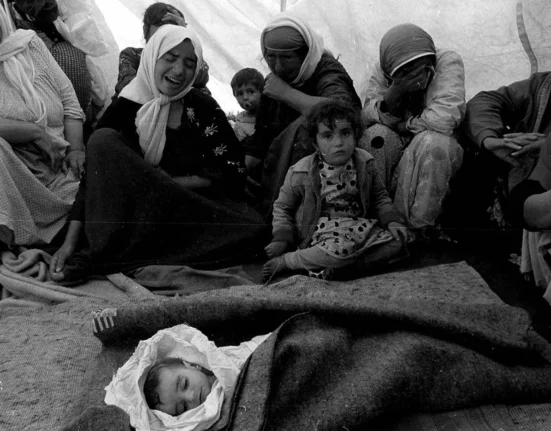
Subsequently, under Decision No. 916 and nearly 30 similar resolutions, all movable and immovable properties of the Fayli Kurds were confiscated, including their personal belongings and assets essential for daily life. These policies were accompanied by severe and brutal actions against the Fayli Kurds, including the abduction of women, the killing of men and children, and the separation of families. These crimes are considered among the most severe violations in modern history.
All these crimes were implemented through dozens of resolutions issued by the dissolved Revolutionary Command Council, the most significant of which were Decisions No. 666, 180, 916, and 474. Furthermore, hundreds of intelligence, military, and administrative committees were established to implement these systematic policies, to execute orders, and ensure the continuation of the genocide process against the Faili Kurds.
These measures are further supported by official Iraqi state documents issued during the Ba’ath regime period, which provide clear evidence of the systematic and organized nature of the genocide against the Faili Kurds.
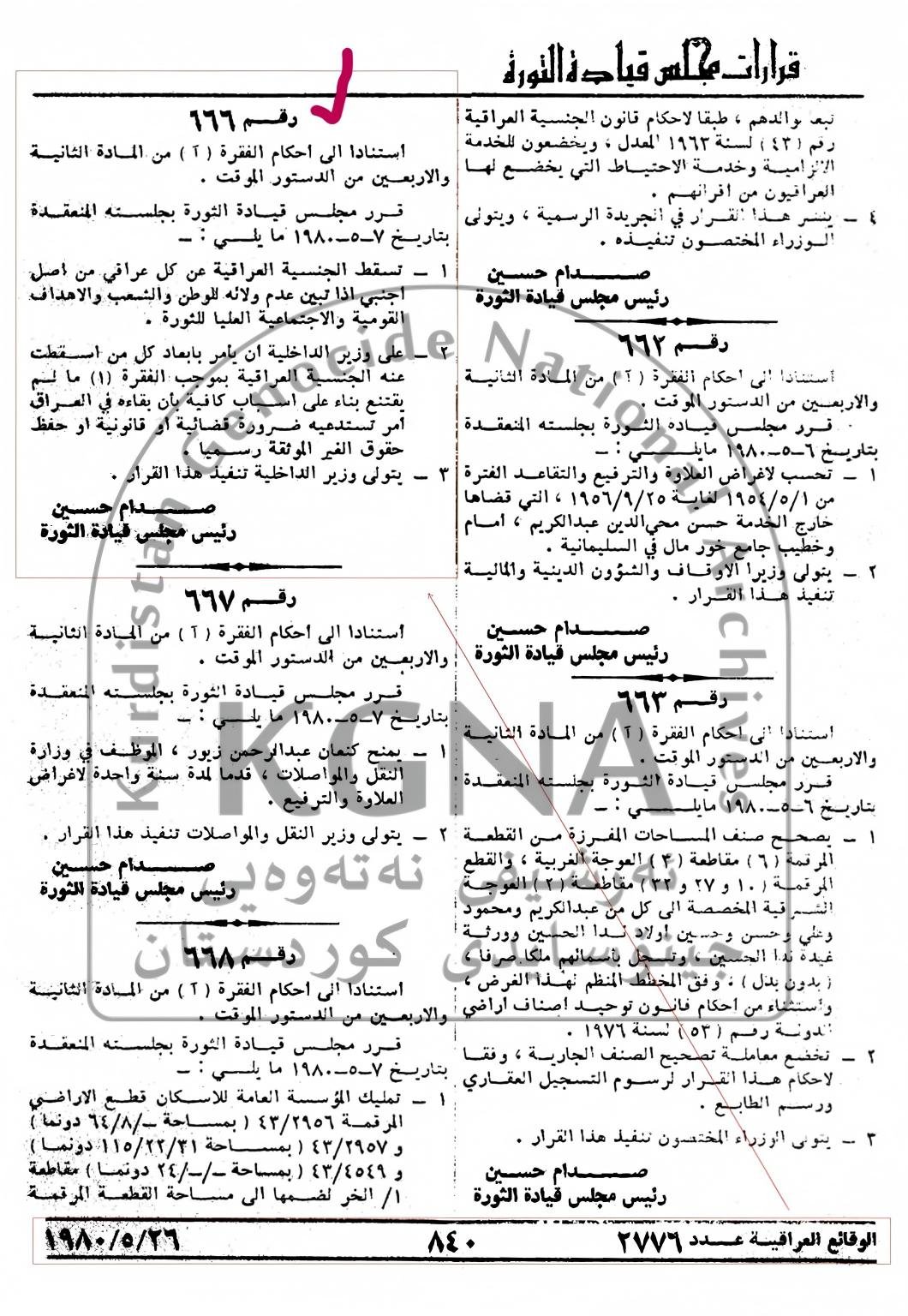
Resolution No. (666): The Legal Foundation of the Genocide of the Faili Kurds
One of the most important legal documents related to the genocide of the Faili Kurds is Resolution No. (666) issued by the dissolved Revolutionary Command Council on May 7, 1980. This resolution constituted one of the primary legal foundations through which the Ba’ath regime initiated the process of deportation and ethnic cleansing of the Faili Kurds.
The content of Resolution No. (666) included the following key measures:
Revocation of Citizenship
The Ba’ath regime ordered the revocation of Iraqi citizenship from all individuals whose “origins traced back to another country,” specifically targeting the Faili Kurds, under the pretext that they lacked loyalty to the Iraqi state.
Deportation and Forced Expulsion
Under this resolution, the Ministry of Interior was granted full authority to deport individuals whose citizenship had been revoked, forcibly expelling them beyond Iraq’s borders.
Confiscation of Property
Following the deportation of the Faili Kurds, their homes, assets, and financial resources were confiscated. This constituted a central component of the policy aimed at destroying the economic foundations of the Faili Kurdish community.
This resolution effectively granted legal authority to the Ba’ath regime to implement:
- Revocation of identity documents
- Revocation of citizenship
- Deportation and forced displacement
- Confiscation of movable and immovable property
- Ethnic cleansing
Resolution (666) was implemented extensively and became the primary legal basis for the genocide of the Faili Kurds in 1980. It was later reinforced by additional resolutions, including 180, 916, and 474, which further expanded the systematic policies against the Faili Kurds.
These official documents clearly demonstrate that the genocide of the Faili Kurds was not merely a political or military action, but rather a structured state-led process implemented through official decisions and formal directives. This aspect holds particular significance within genocide studies and transitional justice research, as it demonstrates the organized and institutional nature of the crimes committed against the Faili Kurds.
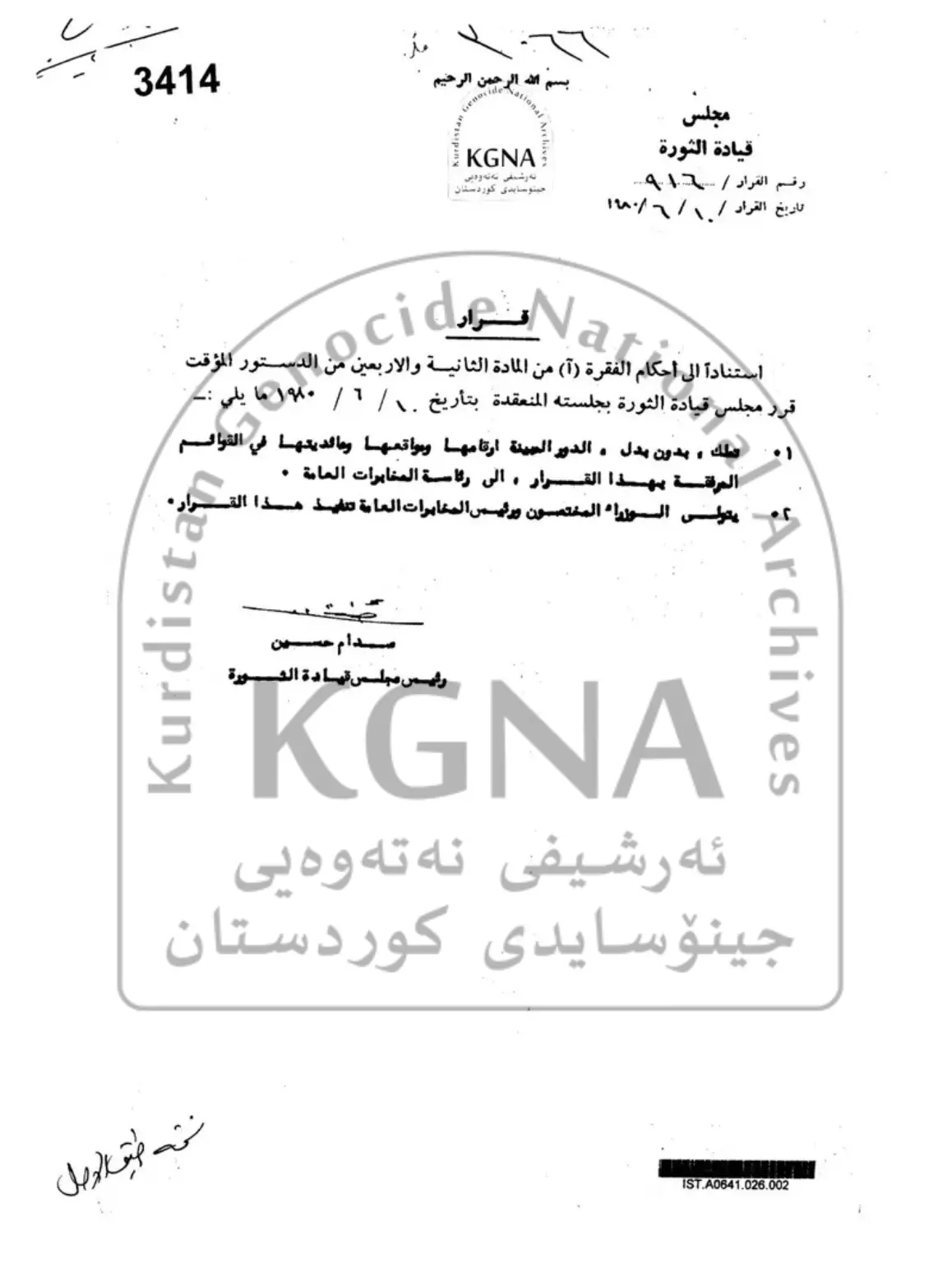
Resolution No. (916): Confiscation of Property as a Legal Instrument of the Faili Kurdish Genocide
Basic Information of the Document
- Issuing Authority: Revolutionary Command Council (RCC)
- Resolution Number: 916
- Date: 10 June 1980
- Issued by: Saddam Hussein
- Type of Document: Official Government Resolution
Content of the Resolution
According to Resolution No. (916), the Iraqi state ordered the confiscation of all movable and immovable property belonging to individuals referred to under the related legal provisions, without compensation. This included houses, land, financial assets, businesses, and all personal belongings belonging to the Faili Kurds.
The implementation of this resolution was assigned to the Ministry of Finance and other relevant governmental institutions, which were tasked with executing the confiscation process and transferring ownership of the properties to the Iraqi state.
Significance of the Document
Resolution No. (916) represents one of the most important legal documents demonstrating that:
- The genocide of the Faili Kurds was an official state policy
- Confiscation of property was carried out through formal legal mechanisms
- Crimes were implemented through high-level governmental orders
- The genocide was systematic, organized, and state-sponsored
This resolution also demonstrates that the Iraqi Ba’ath regime sought to legalize its crimes through formal governmental decisions, transforming acts of ethnic persecution into official state policy.
Official Ba’ath regime documents clearly show that the genocide of the Faili Kurds was not merely a political policy, but rather a formal and legalized state-led process. Among these documents, Resolution No. (916) issued by the Revolutionary Command Council on June 10, 1980, ordered the confiscation of all movable and immovable property belonging to the Faili Kurds without compensation.
This resolution constitutes one of the key legal documents proving that the genocide of the Faili Kurds was carried out through official state orders and implemented in a systematic and organized manner, which holds significant importance in genocide studies and transitional justice research.
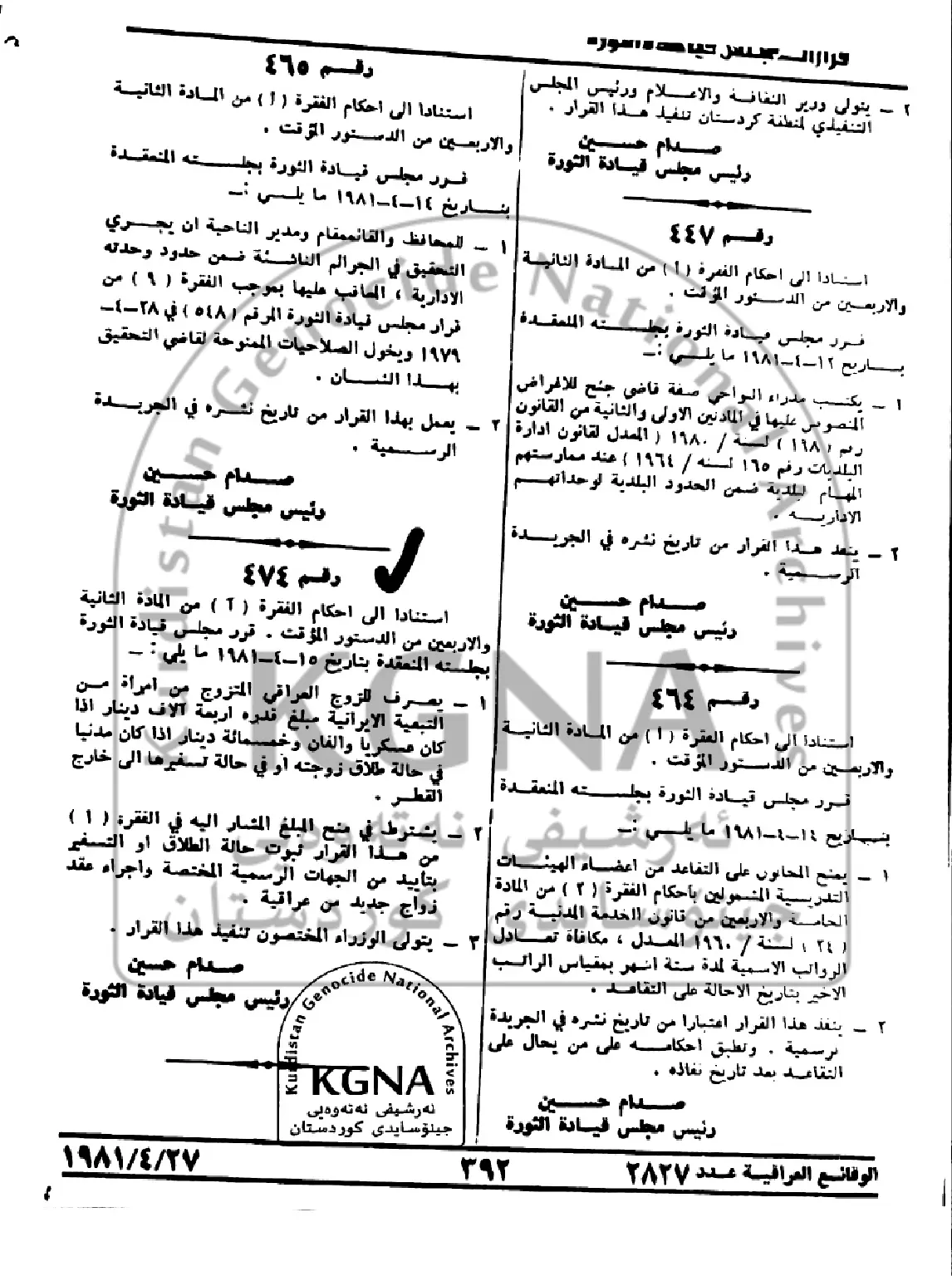
Family Disintegration and Social Cleansing under Resolution No. 474
During the policies of repression and violence implemented by the Ba’ath regime, the Faili Kurds were subjected to the systematic disintegration of families and social fragmentation. Within the framework of the genocide of the Faili Kurds, the Ba’ath regime did not limit its actions to deportation and confiscation of property; rather, it targeted the fundamental structure of society — the family — to dismantle familial and social bonds.
In this context, Saddam Hussein, former President of Iraq and leader of the Ba’ath regime, issued Revolutionary Command Council Resolution No. (474) on April 15, 1981, representing another step in the genocide against the Faili Kurds. The resolution stated:
“Iraqi men whose wives are Faili Kurds must separate from them, and they will be rewarded with four thousand dinars if they are military personnel, and two thousand five hundred dinars if they are civilians” (according to the former Iraqi currency).
This resolution clearly represented a systematic attempt to dismantle families and separate Faili Kurdish women from Iraqi men. This policy formed part of the broader strategy of ethnic cleansing and the destruction of the national identity of the Faili Kurds.
Official documents and decisions issued by the Revolutionary Command Council demonstrate that the genocide of the Faili Kurds was not limited to killing and deportation, but also included an organized effort to destroy their social and familial foundations. This constitutes one of the key characteristics of genocide under international law and genocide studies
Killing, Enforced Disappearance, and Displacement of the Faili Kurds
During the genocide of the Faili Kurds, approximately 23,000 individuals between the ages of 18 and 28, representing the productive force and future of the community, became targets of the Ba’ath regime’s ethnic cleansing policies. These young men were eliminated in various ways:
- Some were executed by hanging
- Some were sent to minefields during the Iran–Iraq War
- Others were used in chemical weapons testing
- Some were subjected to brutal treatment in secret detention facilities and acid pits
To this day, the fate of many of these individuals remains unknown, and they are classified as forcibly disappeared.
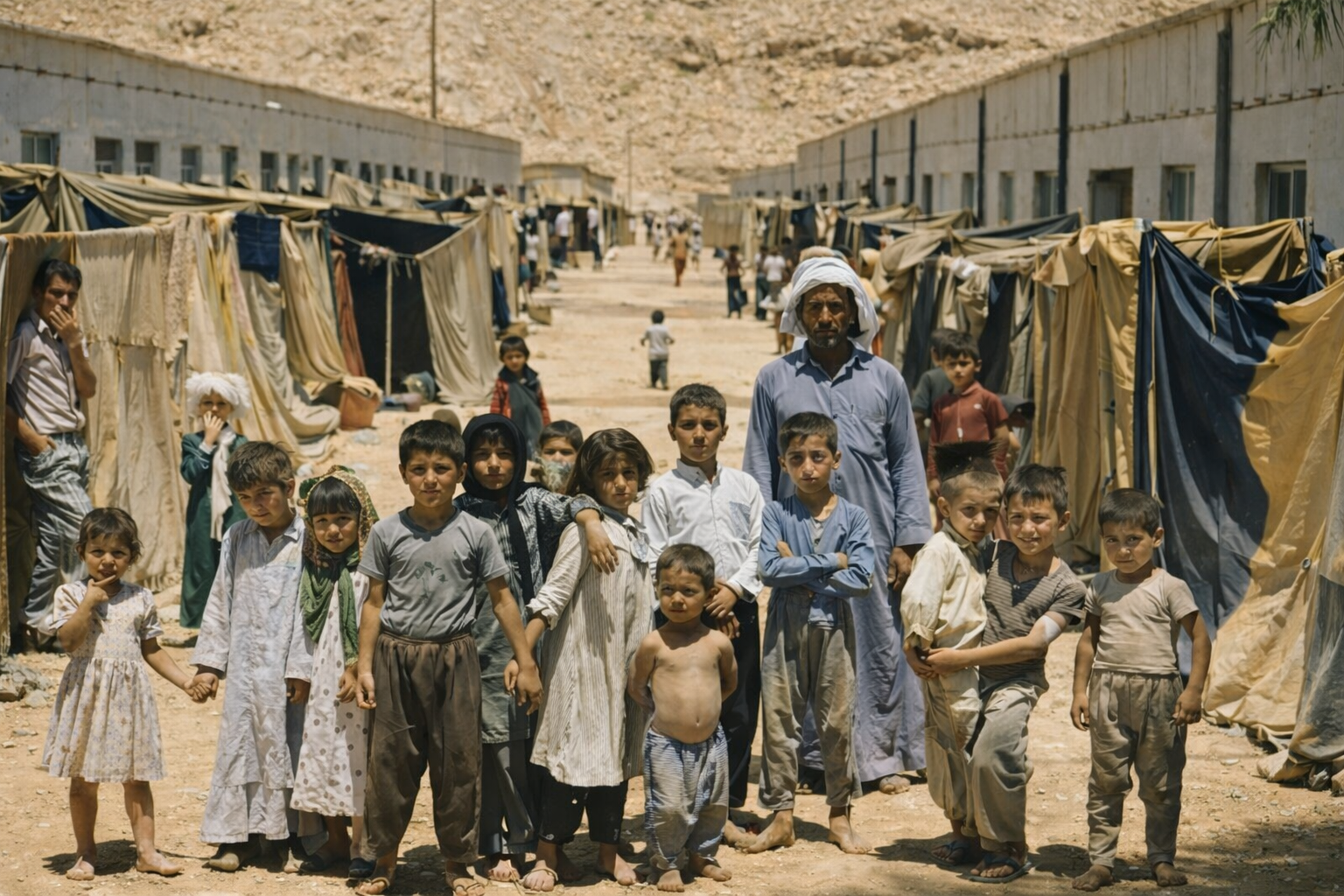
At the same time, according to available documentation and statistical data, approximately 750,000 Faili Kurds were forcibly deported, displaced, and rendered refugees. Most of them lived for years in refugee camps in Iran under extremely harsh conditions characterized by humiliation, displacement, and hardship. Thousands of families remained hopeful for their return to their homeland; however, many never returned and died in exile under refugee conditions.
As an example, this document represents a Presidency of the Revolutionary Court decision, which constitutes one of the legal documents related to the killing and execution of Faili Kurds in 1980.
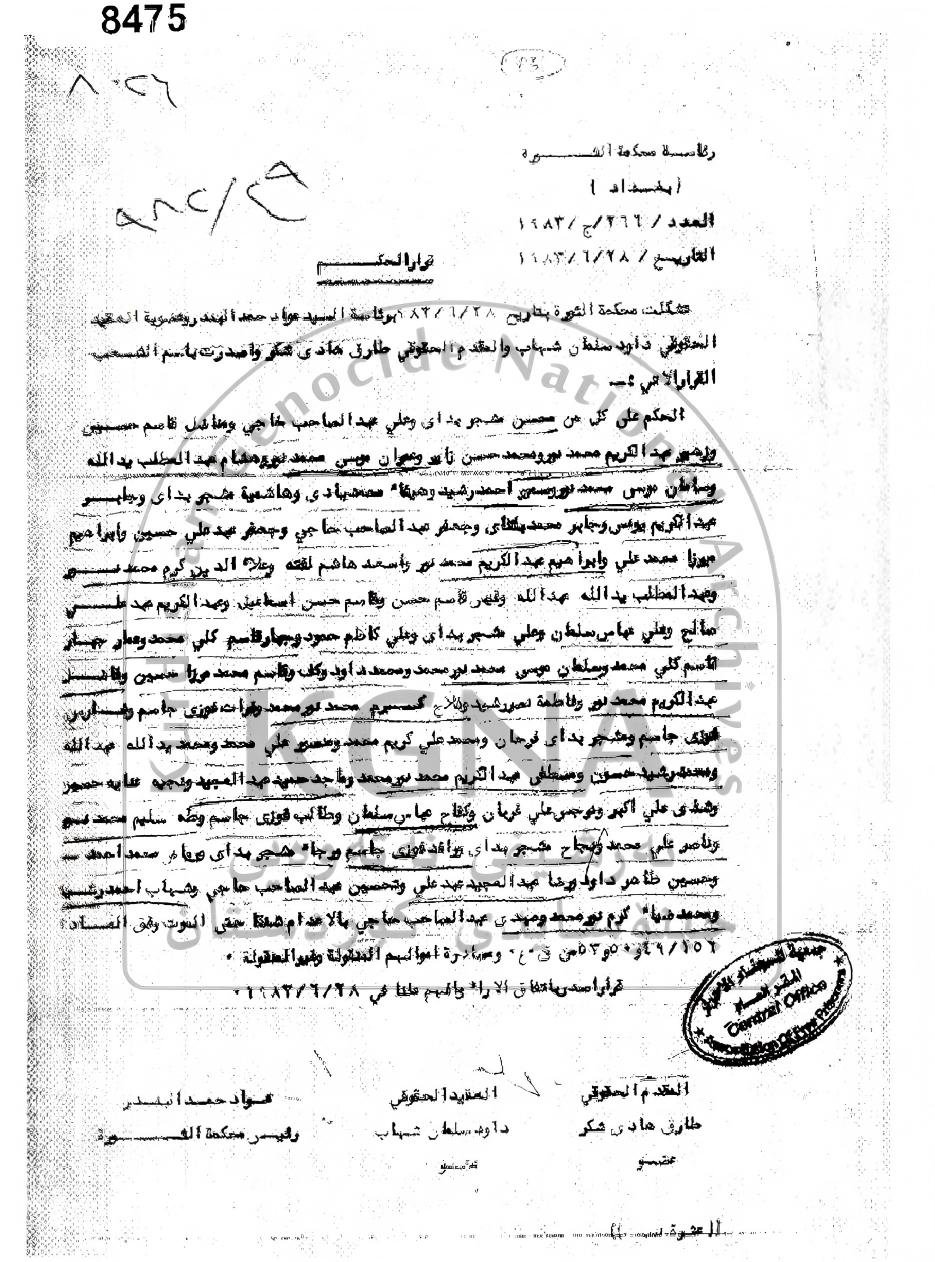
Basic Information of the Document
- Issuing Authority: Presidency of the Revolutionary Court (Riasat Mahkamat al-Thawra)
- Judgment Number: 361 / J / 1983
- Date: 28 / 6 / 1983
- Court Location: Baghdad
- Type of Decision: Death Sentence (Execution by hanging until death)
Content of the Document
This document shows that the Revolutionary Court of the Ba’ath regime issued death sentences against a group of individuals, the majority of whom were the Fayli Kurds.
The document includes the names of numerous individuals accused of “political crimes” or “connections with Iran”, which at the time represented a commonly used pretext by the Ba’ath regime to justify the execution of the Fayli Kurds.
At the end of the document, the ruling clearly states:
“الحكم بالإعدام شنقاً حتى الموت”
“Sentence of execution by hanging until death.”
Significance of the Document
This document holds significant importance because:
- It constitutes an official document proving the killing of the Fayli Kurds
- It demonstrates that executions were carried out under formal court rulings
- It confirms that the genocide was systematic and state-organized
- It represents legal evidence for genocide research and documentation
Documents issued by the Revolutionary Court of the Ba’ath regime demonstrate that the genocide of the Faili Kurds was not limited to deportation and displacement, but also included systematic execution of young men. One such document is the Revolutionary Court ruling No. (361/J/1983) dated 28 June 1983, in which a group of individuals — most of them Faili Kurds — were sentenced to execution by hanging until death.
This document clearly demonstrates that the killing of the Fayli Kurds was carried out through formal state orders and legal institutions of the Ba’ath regime, and constitutes one of the key pieces of evidence demonstrating the systematic nature of the genocide against the Fayli Kurds.
Legal Status of the Fayli Kurds After 2003
Following the fall of the Ba’ath regime in Iraq in 2003, important legal steps were taken to address the injustices committed against the Faili Kurds. In 2006, the Iraqi Nationality Law annulled Resolution No. (666) of 1980, which had stripped the Faili Kurds of their citizenship. As a result, many Faili Kurds were able to regain some of their legal rights, particularly Iraqi citizenship.
However, despite this legal step, many Faili Kurds continued to lack trust in the Iraqi state due to the grave crimes committed against them. In general, many still face legal, social, and economic challenges. In some cases, they continue to be treated as foreigners or second-class citizens, reflecting the lasting consequences of the genocide and the incomplete implementation of transitional justice following the genocide period.
The Faili Kurdish Genocide Case Before the Iraqi High Criminal Court
After the fall of the Ba’ath regime in 2003, the genocide of the Faili Kurds was referred to the Iraqi High Criminal Court as one of the major crimes committed against the Kurdish people.
On December 21, 2008, the case of the Faili Kurdish genocide was formally brought before the court. After a period of investigation and review of documents and statistical evidence, the court issued a formal ruling on November 29, 2011, recognizing that the crimes committed against the Faili Kurds constituted genocide.
This ruling was later approved by the Council of Representatives of Iraq and the Iraqi federal government, representing official legal recognition of the genocide of the Faili Kurds.
However, despite this formal recognition, the living conditions of the Faili Kurds have not returned to their pre-crime status, and many of their fundamental issues remain unresolved.
These include:
- Full restitution of confiscated property
- Material and moral compensation
- Clarification of the fate of thousands of victims
- Continued problems related to nationality and identity documents
Furthermore, despite the recognition of the genocide, the Iraqi government has taken limited practical steps beyond political declarations and formal decisions to compensate victims and address their conditions. As with other cases of genocide against the Kurdish people, this situation reflects the continuing impact of these crimes and the incomplete implementation of transitional justice.
♦ Note
1. The above text is a summary of my research presented at the International Scientific Conference on the Genocide of the Kurdish People of Kurdistan (Genocide of the Faili Kurds), held on 2–4 May 2023. My paper was presented on the third day, 4 May 2023, at 11:00 a.m., in the second panel titled “Documenting the Genocide of the Faili Kurds through Scientific Methods.” The title of my research was “Archiving the Documents of the Fayli Kurdish Genocide: A Vision for the Future.”
2. Regarding the use of the term “Faili Kurds” instead of “Pala Kurds” or “Palayi,” this is because all official Iraqi state documents across different periods have used the term “Faili.” Therefore, the use of this designation does not imply assimilation, which refers to the erasure of a nation’s identity, language, and authentic culture through planned cultural policies imposed by a dominant group. This is not the intention in this context.
Leave feedback about this