



The Third Phase of the Anfal Genocide: The Attack on Germian(7–20 Apr 1988)
The third phase of the Anfal Genocide was among the most destructive and brutal campaigns carried out by the Iraqi state under the Ba‘ath regime. Following the second Anfal phase and the mass arrests in Qaradagh, the regime launched another major offensive—this time against the Germian region.
From 7 to 20 April 1988, under the command of Lieutenant General Sultan Hashim (Commander of the First Corps) and Lieutenant General Kamel Sajit (Commander of the Second Corps), and under the direct supervision of Adnan Khairallah (Minister of Defense), Ali Hassan al-Majid (Head of the Northern Bureau of the Ba‘ath Party), Nizar Abdul Karim al-Khazraji, and Hussein Rashid al-Tikriti, massive military operations were carried out.
Entire districts — Duzkhurmatu, Qader Karam, Kifri, Kalar, Chamchamal, Tileku, Pebaz, Sangaw, Tekye, and Aghjalar — were devastated. According to official documents, more than 500 villages were destroyed, and nearly 30,000 civilians, including women, children, and the elderly, were arrested and forcibly disappeared.
Witnesses reported that local Ba‘ath officials and Jash (Kurdish collaborators) spread propaganda promising families 300-square-meter plots of land and new houses “in better areas,” to lure them out of their homes—only to detain or execute them later.
The Germiyan Anfal represented the most severe escalation of the campaign. Despite fierce resistance, Peshmerga forces, exhausted and cut off from supplies, were unable to withstand the overwhelming firepower. Many civilians fled into the mountains to escape air and chemical attacks. The Iraqi army systematically looted and razed the entire region, killing or deporting anyone remaining.
The operation unfolded in three main offensives:
- The Duzkhurmatu front began on 7 April, marking the anniversary of the Ba‘ath Party’s founding. Iraqi forces launched from several bases, burning and flattening surrounding villages.
- The second front, supported by the 65th Special Forces Brigade and National Defense Units (58 and 200), advanced from Kirkuk, Chamchamal, and Sangaw toward Qader Karam, destroying 17 villages and committing mass killings in Dawe, Zinan, and Belegey Gawra. In Dawe alone, 11 Peshmerga were killed, and 3,281 civilians were executed.
- The third front targeted Tazashar village, due to its strategic location between Duzkhurmatu and Qader Karam. On 9 April, the villages of Kani Qadri (Upper and Lower), Awai Sheikh Hameed, Karim Basam, and Aziz Beg were burned, and their inhabitants disappeared.
By the end of this phase, Germian was almost completely depopulated—its villages annihilated, and its people either killed or driven into exile.
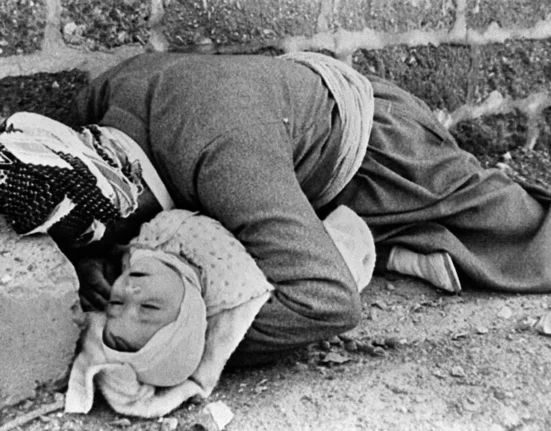
Although the official discourse and published reports on the Third Phase of the Anfal Genocide do not mention the use of chemical weapons, many eyewitnesses testify that they themselves saw chemical weapons being used. Even in the field communications of the Iraqi army commanders, there are recorded radio conversations between officers indicating that, to “eliminate the saboteurs and yakhibûn (those who disturb the order), gas was the only way to break their resistance.”
A British Hawker Hunter aircraft was seen bombing Tazashar village, and a large amount of white powder and residue was observed there. A woman from the village of Sheikh Hameed later testified that she saw the bodies of 25 Peshmerga who had suffocated from gas. At first, she did not understand that they had been killed by chemical gas, but when she noticed that many goats, cattle, and other livestock had also died in the same area, she realised that a chemical agent had been used.
There is also the possibility that on 10 April, a second chemical attack took place. A shepherd from the village of ‘Alawi recounted that some Peshmerga who had passed through the area fled in that direction at night, and around midnight an aircraft bombed the region; as a result, ten people were killed.
The second offensive was directed at Qader Karam and the northern part of Germian. The forces that had set out from Kirkuk and Chamchamal and advanced towards Qader Karam reached the area on 10 April under the supervision of Colonel Barq ‘Abdullah al-Hajj Hanta al-Zubaidi, commander of the Special Forces. They encountered no resistance from Peshmerga or civilians and suffered no losses. In this operation, a Jash force destroyed the two villages of Chepek and Ibrahim Ghulami.
The village of Ibrahim Ghulami, which belonged to the Zangana tribe and was closely linked to the Jabbari area, became the victim of the harshest destruction, looting, and burning during the third Anfal phase. In almost all these attacks, the Kurdish Jash would go in front of the Iraqi army into the villages; if there was any fighting, they were the first to be struck, and if there were no fighting, they would plunder, burn, and destroy everything in the village.
Most of the villagers had already taken refuge in the mountains, but some—out of necessity—fell into the hands of the army and were later deported (disappeared). This area was highly strategic and valuable, not only because it was an active Peshmerga zone, but also because of its proximity to the oil-rich city of Kirkuk. For this reason, the Iraqi regime arrested the people of the region ruthlessly and fiercely and treated and deported them without mercy, making no distinction between old and young, men and women, or children and adults. According to one statistic, 539 people from the Jabbari area were subjected to Anfal (disappeared).
One of those villages was Qircha. Early in the morning, after the attack and the arrest of the men, they were gathered in one place, their hands tied behind their backs, and then taken under guard to unknown locations. Among the Jash and Mukhtars who participated in the Third Anfal in this area were: the Badnaw Mutassim Barzanji, ‘Adnan and Sayed Jabbari, Rif‘at Guli, Qasim Agha, and Tahsin Shaways. They played a direct role in handing over the people of the area, who were then deported and disappeared.
The mustashars (local pro-regime chiefs) falsely reassured the villagers, telling them that if they surrendered themselves voluntarily to the army, they would be pardoned and nothing would happen to them. One woman reportedly said to a mustashar: “Help me escape from the army.” He replied: “There is nothing I can do for you; you should hand yourself over.”
Some mustashars and Jash, after witnessing women and men being separated and taken away, realised what they had done and regretted their role. In Intelligence Bulletin No. 10340 of Duzkhurmatu, dated 10 April 1988, it is reported that one of the Jash units, Unit 25, refused to continue its assigned tasks and was withdrawn from the area.
The third major offensive was directed against Sangaw and southern Germian. After the first two offensives against Duzkhurmatu and Qader Karam (northern Germian), the regime launched yet another large operation against Sangaw and the southern parts of Germian.
The army, coming from multiple directions, attacked, destroyed villages, and arrested the villagers en masse. This wave of the Anfal destroyed the largest number of villages in that region and led to the mass deportation of a huge number of inhabitants. For example, on 14 April, in the two villages of Mala Sur and Kolejow of Haji Hama Jan, within a single day, a huge number of people were arrested and deported — men, women, children, and the elderly together.
The Sangaw area, which alone contained 93 villages, had approximately 18,000 inhabitants before the campaign; most of them were either subjected to previous attacks or deported in this phase. The villages affected by the campaign in Sangaw included: Darawar, Banimurd, Penj Angusti, Haji Muhammad Agha, Penj Angusti Sheikh Mustafa, Hanjira, Segumatan, Kelabarza, Darzila, Qalaga, and Dar Baru. Some of the civilians and Peshmerga who had fled southwards from the Qader Karam and northern Germian fronts to escape were also arrested and deported there.
The southern Germiyan areas, which shared a border with the Arabised districts of Diyala, were attacked on the morning of 9 April when large forces moved out from Kifri, Kalar, Pebaz, and Pongala. The core military strategy was the same as in the northern Germiyan front: a wide encirclement from several directions, cutting off all routes, then rounding up the population collectively, destroying their villages, and looting their property.
The commander of the Kifri forces was an unnamed brigade commander called Sami, belonging to the First Corps under the overall command of Lieutenant General Sultan Hashim. On 10 April, about 20 villages in the region were completely levelled, including Chwarshakh, ‘Aliyani Taza, Tokan, Mil Qasim, Duraji, Belgey Gawra, Belgey Chuk, Omer Bel, and others. Units from the 417th and 418th Infantry and the 100th, 131st, and 197th National Defense Battalions participated in these attacks, occupying the villages and deporting their inhabitants.
The second joint force, which set out from Kalar under the command of Naqib (Captain) ‘Abd ‘Awwad of the 417th Infantry Battalion, attacked the village of Duraji on 11 April, south-east of Omer Bel. The people there were immediately taken into custody and transferred to a special prepared camp near the 21st Infantry Division.
On 13 April, the forces reached Kolejow village. Before their arrival, some villagers tried to escape with a few belongings towards the Samud complex, but because the only remaining road between Kifri and Kalar was blocked, they were forced to head towards Mala Sur. When the army arrived, the village was destroyed by bulldozers.
On 17 April, Kuna Kotra village was destroyed and looted; its houses were demolished, and the remaining population arrested and deported. On 18 or 19 April, the forces of Kifri and Kalar completed their assigned tasks within the Third Anfal, and most of the villages in Sangaw and southern Germian had been completely levelled. Peshmerga forces had put up fierce resistance, but because the army continuously increased its manpower and had virtually unlimited artillery and ammunition at its disposal, the Peshmerga could not hold out indefinitely.
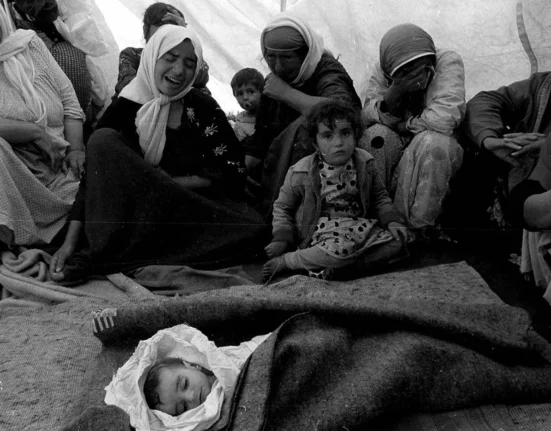
After rounding up and deporting the population of these areas, the Ba‘athist Iraqi regime launched an extensive propaganda campaign to portray those who had been arrested as “saboteurs, criminals, mercenaries and Iranian agents”. To this end, the authorities filmed the detainees — women, children, the elderly, and young men — and broadcast these images repeatedly on television for several weeks, in an attempt to justify the campaign and to stigmatise the victims.
However, the National Security Council of Iraq, in a secret and special memorandum No. 397 dated 2 May 1988, addressed to the Ministry of Interior and forwarded to the Northern Affairs Committee and the General Security Directorate, complained that broadcasting such images — showing women, children, and elderly people — could be harmful and might trigger public reaction and protests against the government.
At the same time, Kurdish political forces and representatives of Kurdistan’s front organisations worked to inform the outside world about the chemical bombardments, the genocide against the Kurds, and Iraq’s violations of international conventions. They submitted memoranda and lists of Iraqi military operations to the UN Security Council, detailing the attacks carried out by Iraqi forces against the Kurdish population between 15 April 1987 and April 1988, including the use of chemical weapons. Attached to these memoranda were copies of official Iraqi documents about “prohibited areas” in Kurdistan.
Once again, on 24 February 1989, the Kurdistan Front sent another memorandum to the UN Human Rights Commission, listing the victims of the Anfal from villages in the governorates of Kirkuk and Sulaymaniyah, focusing on March and April 1988. The figures presented included:
- Nearly 728 villages and small towns were destroyed,
- 40,000 families deported, of whom 16,000 were detained in regime prisons,
- 7,407 women from the Zangana, Jabbari, and Sangaw areas were held in Dibis prison,
- 5,600 women from various regions were held in the Yaychi sub-district,
- 4,560 children were detained alongside their mothers, many of whom died in captivity,
- Numerous infants aged six months to one year reportedly sold for 50 dinars each,
- 7,640 men disappeared (deported),
- And widespread violations of the dignity and bodily integrity of women, far beyond any human or legal norms.
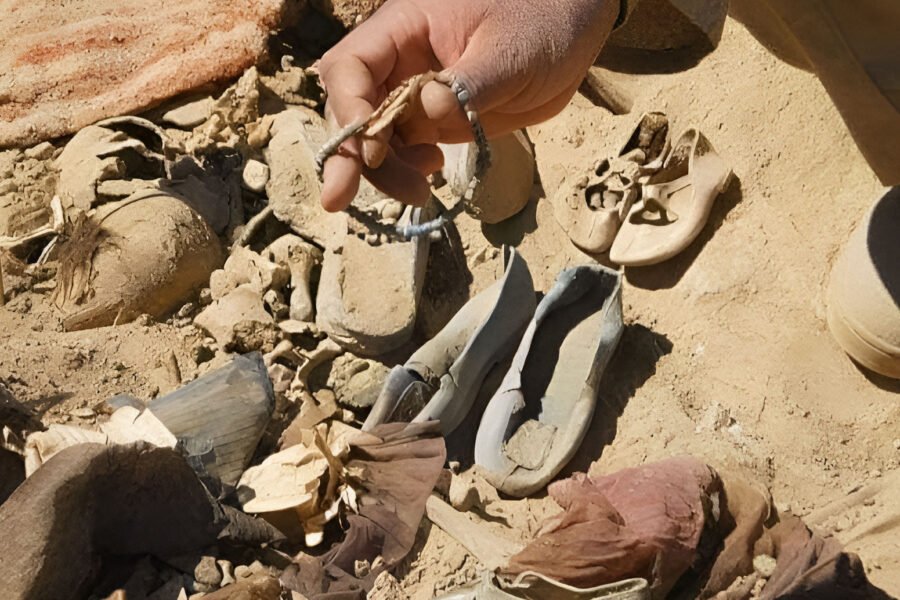
After the collapse of the Ba‘ath regime, hundreds of mass graves were uncovered, many of which contained the remains of victims from the Germiyan region.
However, a large number of Anfal victims are still missing, and their fate remains unknown to this day.
Leave feedback about this