



The Final Phase of the Anfal Genocide in Badinan, 25 Aug to 6 Sep 1988
The Anfal in Badinan, from 25 August to 6 September 1988, in a field report of the Final Anfal drawn from the decisions and documents of the Ba‘ath regime [1].
The end of the Iran–Iraq war provided strong political and military leverage to the Iraqi state, significantly enhancing its army’s capabilities. This prompted the Ba‘ath leadership to hasten the completion of the Anfal campaign through the Final Anfal Operation. The campaign was commanded by Lt. Gen. Sultan Hashim (1st Corps), Lt. Gen. Younis Mohammed al-Zurb (5th Corps), and Lt. Gen. Kamel Sajit (2nd Corps), under the direct supervision of Gen. Adnan Khairallah, Minister of Defense, Ali Hassan al-Majid, head of the Northern Bureau of the Ba‘ath Party, Gen. Nizar Abdulkareem al-Khazraji, Deputy Chief of Staff for Operations, and Gen. Hussein Rashid Mohammed al-Tikriti.
A secret report titled “Review of the Final Anfal Operations” (No. H2/2422, dated 25 Dec 1988), authored by Lt. Gen. Younis Mohammed al-Zurb, commander of the 5th Corps, and sent to the General Command of the Armed Forces, detailed the earlier phases (5th, 6th, and 7th Anfal) and defined the deployment of corps and National Defense forces in the area.
The report spans over 61 pages and constitutes one of the most critical official documents later used as key evidence to establish the genocidal nature of the Anfal operations before the Iraqi High Criminal Court. It demonstrates the continuation of mass killings in Kurdistan even after the ceasefire between Iraq and Iran.
One section reads: “Ali Hassan al-Majid held several crucial meetings before launching the final operations to compensate for the lack of success in Anfal phases 5, 6, and 7.”
On 7 August 1988, in Kirkuk, al-Majid met with northern coordination officials and army commanders to plan the economic and military dimensions of the Badinan Anfal. This is referenced in the secret Memorandum No. 1024 (August 8, 1988).
A subsequent meeting on 14 Aug 1988 determined the positioning of the 1st Corps in Balisan and Smaqûli, and the 5th Corps in Ziwakan–Zakho, in preparation for the Eighth Anfal Phase, as noted in secret Memo No. 1076 (16 August 1988).
Further orders on 21 Aug 1988 (Memo No. 1122) authorized the use of chemical weapons, and the attack date was fixed for 28 Aug at the 26 Aug meeting in Kirkuk (Memo No. 1175, 27 Aug 1988).
The report identifies Badinan as “a mountainous stronghold of the Kurdistan Democratic Party under the leadership of Masoud Barzani.” Under Saddam Hussein’s direct orders, civilians in the area were given a short amnesty to return to “the national ranks,” and fighters who surrendered would be spared.
A separate memorandum issued by the Sulaymaniyah Security Directorate on “ July 11, 1988, detailed this new policy on voluntary surrender of Peshmerga, listing specific directives issued by Ali Hassan al-Majid.
- Any fighter (Peshmerga) who surrendered himself and handed over his weapon, returning to areas not yet subjected to the Anfal operations, would be pardoned for all previous crimes, including desertion from military service.
- Any unarmed returnee to areas untouched by Anfal would also be exempted from accusations of aiding rebels or dereliction of duty.
- No individual shall be allowed to enlist in the “National Defense Forces” without official authorization.
In reality, none of these promises made by the Ba‘ath regime at the beginning of the Anfal campaign were ever fulfilled. No amnesty was granted, and no respect was shown to the surrendering civilians. Many who trusted those pledges and gave themselves up met a tragic fate — they were arrested and forcibly disappeared.
According to Ba‘ath regime documents, the Anfal operations in Badinan extended westward from Zakho to Amêdî, and east and southward covering Sheikhan and Aqra, particularly the areas of (Kani Masi, Begova, Batofa, Dêralok, Sarsing, Zakho, Atrush, Shirwan Mazin, Aqra, and Dinarta). Thousands of residents fled their homes in fear of chemical bombardment and mass disappearance.
In this campaign, besides the 5th Corps headquartered in Erbil, the 1st, 2nd, 3rd, 4th, 5th, 6th, and 7th Corps participated, involving 18–20 combat brigades, divisions (38, 42, 29, 35, 41, 45), and the 5th National Defense Force. Corps 3, 6, and 7 were redeployed from southern Iraq to reinforce the offensive.
These areas were under the control of the Kurdistan Democratic Party (KDP), the Peshmerga. The mountainous geography complicated logistical support for the Iraqi army. The attacks on KDP strongholds in Badinan were even more extensive and direct than those previously launched against the Patriotic Union of Kurdistan (PUK), due to the army’s increased capacity after the Iran–Iraq ceasefire.
During the operation, many Assyrian, Catholic Christian, and Yazidi civilians, like Muslim Kurds, were detained and disappeared. Assyrian villages such as Blav (Brawary Bala), Mize (Sarsing), and Kosa (Dohski) were burned and bulldozed along with neighboring Kurdish villages.
Those who managed to escape fled into the mountains, and hundreds crossed into Turkey, where they remained until the general amnesty of September 6, 1988.
Chemical Bombardments during the Final Anfal Phase in Badinan
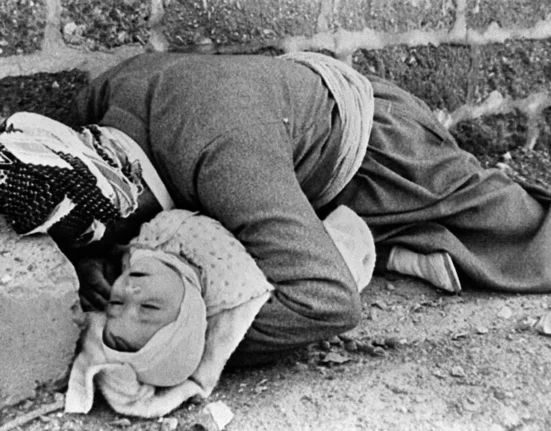
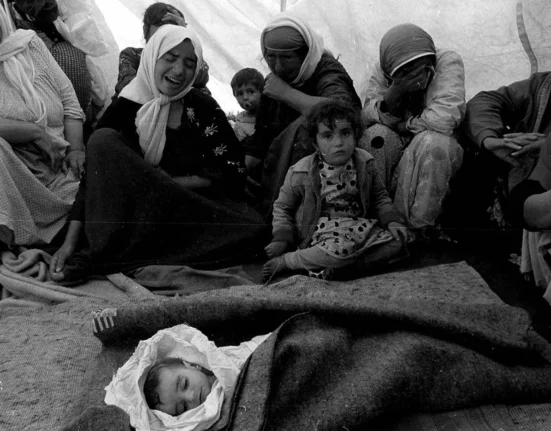
One of the darkest crimes in the history of the Iraqi state under the Ba‘ath regime was the extensive use of chemical weapons, which had been prohibited under the 1925 Geneva Protocol.
According to the Ba‘ath regime documents, the following areas were targeted by chemical bombardments:
- On 24 August 1988, Mount Gara and the village of Zewashkan in Duhok were chemically bombed, killing 10 Peshmerga fighters.
2. On 25 August 1988, the eighth and final phase of the Anfal Genocide began. Chemical bombardments targeted Amedi and Berwari Bala, including the villages (Warmilê, Bapirê, Geregû, Hesê, Ikmala, Asehê, Bazê, Miska, Mêrga Chiya, Kanî Belav, Tilakroy, Kharabiya), killing 5 civilians and injuring 75.
3. That same day, other areas of Duhok, such as Amedi, Sari Gara, and the villages (Kiri, Bawaka, Berkevre, Gerka, Sartke, Zewka, Sherwane, Blejane, Bane, Tilakrd) were chemically bombed, resulting in 2 deaths and 40 injuries, while 46 villages around Amedi were destroyed.
4. On 25 August 1988, villages (Gelneske, Kania, Baska, Avoke, Bimnanesh, Prisa, Jizgira, Chamchali, Chamshruisa, Nezdure, Bareye, Cham Rabatke, Miruke, Belmbas) were chemically attacked.
5. On 25 August 1988, villages (Bergini, Zerhewa, Dergala Sheikh, Zinava, Dbanke) were bombed, killing 14 people and injuring 15.
6. On the same day, in the Shekhan district, villages (Spindariya, Suwar) and the southern slopes of Mount Gara (Alok, Sidra) were bombed with chemical weapons.
7. Northern parts of Mount Gara, including (Mergatwi, Zewka, Shan, Goharz, Sare Kokê, Twika near Zakho), were also attacked.
8. The village of Gweze and nearby central mountain villages were bombed chemically.
9. The Kani Masi and Baluka districts were also targeted.
10. Villages near Amedi — (Sper, Sinya, Nerwa, Khara Gol, Kujerska, Khrap, Zewa, Berchi, Kani, Dwirê, Dergani, Siri, Sgere, Sarkeli, Frestak, Chiya Reshk) — were bombed, causing many injuries.
11. On 27 August 1988, in Erbil Governorate, the Upper Mzuri area (Zey Rwê Shin valley) was bombed, with several casualties and injuries.
12. On 28 August 1988, in Badinan, villages (Shiviye, Hitut, Kaniya Pink, Bashe, Sarni, Gara, Garu, Bawanki, Zewa Sari, Gali Kutke) were chemically bombed — the number of victims remains unknown.
13. On 29 August 1988, in Berwari Bala, villages (Bazê and Gali Bazê) were attacked, killing 2,980 people and injuring hundreds, though numbers differ among sources.
14. On 29 August 1988, the village of Banke was chemically bombed, killing around 1,000 civilians and injuring many others.
Before launching the assaults on the Badinan region, the Iraqi army and Ba’ath regime mobilized all divisions and military units near Duhok, preparing several sites for heavy aerial bombardment.
One of these locations, the village of Spindariya at the foot of Mount Gara, had previously witnessed the martyrdom of a Peshmerga fighter.
On the evening of 24 August 1988, the headquarters of KDP forces in Zewashkan, where one of its units was stationed, was struck by the first chemical attack, killing ten Peshmerga fighters.
By the morning of 25 August, Iraqi warplanes launched several simultaneous raids across the area. A local witness reported that at 2 a.m. on 26 August 1988, twelve aircraft in formation bombed multiple targets.
The main objective of the regime was to spread terror and panic among the civilian population. The fear of renewed chemical assaults—such as those previously carried out in Halabja, Qaradagh, Guptapa, Askar, Siosinan, Sheikh Wasan, and Balisan—forced thousands of families to flee, clogging the escape routes.
During these attacks, the village of Bergini in the Zawita district was hit by eight aircraft on 25 August 1988. Witnesses described the bombs as releasing large white and black clouds, later turning yellow, rising in thick pillars before dispersing. The gas initially smelled sweet, like apples, but soon caused burning sensations in the mouth, eyes, and skin, making breathing impossible.
Nearby villages — Tilakrd, Spindaroka, and Berkevre — were also bombed chemically, resulting in the death of 14 Peshmerga fighters and several civilians.
In total, approximately 100 districts, villages, and valleys were chemically attacked — one of the most extensive chemical campaigns of the Anfal operations.
Experts believe that the regime used mustard gas combined with nerve agent GB (sarin) during these attacks.
The residents of the area fled toward Begova and Kani Masi.
By 2 a.m. on 26 August 1988, around twenty-five groups of civilians managed to escape, but soon afterward, the Iraqi army captured the surrounding areas, cutting off all routes of retreat.
Peshmerga forces engaged in a series of defensive battles, attempting to blow up bridges and block the army’s advance, but heavy aerial bombardments forced them to withdraw.
By the end of 26 August, the fighting ceased, and by the morning of 28 August, the entire Badinan region was under Iraqi control.
As a result, tens of thousands of civilians became displaced; some fled toward Turkey, while others were arrested or later disappeared after surrendering.
On 26 August, thousands of refugees were trapped along the Turkish border. Initially, Turkish authorities refused them entry, but later, under pressure, opened the border.
An estimated 65,000 to 80,000 people managed successfully to cross into Turkey. During their crossing, clashes broke out between Kurdish refugees and Turkish gendarmerie, as refugees feared being handed back to Iraq.
Eventually, they were settled in temporary camps, where the people of Northern Kurdistan (Bakur) offered substantial humanitarian assistance and helped ease their suffering. [5]
Mass Execution of Women and Children – Korfel Village
Those who surrendered or were captured by the Iraqi army mostly disappeared.
In Korfel village in the Doski area, an Iraqi officer executed 35 civilians — women, men, and children.
A former Iraqi army officer with the rank of Colonel (ʿAqeed) told MEW that they were ordered to kill all Peshmerga, even those who surrendered.
Even civilian farmers were targeted.
All men aged 15–70 were classified as “Peshmerga” and executed under Order No. 4008 issued by Ali Hassan al-Majid.
This order stands as irrefutable evidence of the genocidal intent of the Ba’ath regime.
Massacre in Kurimê Village
In Kurimê, after the villagers surrendered, 33 men and boys aged 13–43 were executed by an Iraqi officer who received the order via military radio.
Six survived:
Abubakr Ali Saeed, Abdulqahar Khalil, Abdulkarim Nayef Hassan, Hashim Mohammed Rashid, Sidqi Abdulqader Fattah, and Fattah Abdulqader Fattah — the latter was re-arrested and executed again at Nizarkê Fortress.
Thirteen survivors were later identified among Anfal mass-grave victims.
Other Villages in Badinan
In Hamza, 48 killed; Korbit Ali, 21; Korbit Timor, 18; Sarkê, 93 men; Warekhel, 83 men; Yekmala Doski, 74; and Gweze, 93 executed.
All were killed during the Badinan Anfal operations.
Mirgatû Village
In Mirgatû (Mirgatê), after arrests, men and women were separated; about 100 men aged over 15 were then executed by firing squad.
Assyrian, Christian, and Yezidi Victims in the Final Anfal
In the final phase of Anfal, many Assyrians, Catholic Christians, and Yezidis were also arrested, disappeared, or killed alongside Kurds.
Assyrian villages such as Balav (Berwari Bala), Mize (Sarsing), and Kosa (Doski) — along with neighboring Kurdish villages — were burned, bulldozed, and destroyed.
An Assyrian priest told Middle East Watch that he had compiled a list of 250 people who disappeared during and after Anfal.
Further interviews with 12 community leaders documented 98 missing persons — including 64 Christians (25 men, 18 women, 12 children) and 34 Yezidis (4 men, 9 women, 21 children).
Most victims were infants under one year old, and the oldest was an 85-year-old woman.
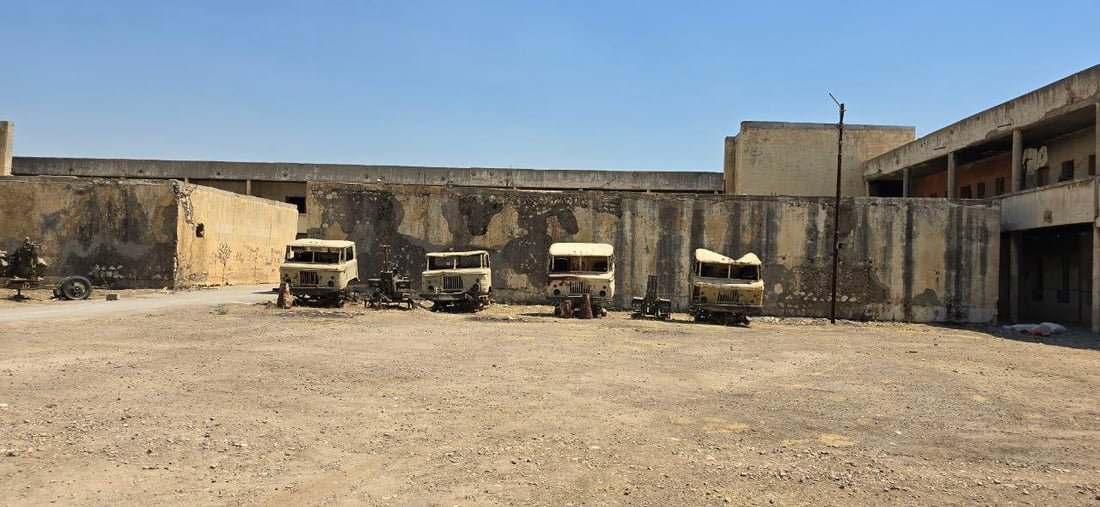
Nizarkê Fortress – Duhok
This military fort, located east of Duhok, is a reinforced concrete structure built in 1970 according to Soviet design, similar in style to the Nugra Salman prison.
After the start of the final Anfal campaign (Badinan phase), detainees were brought directly to this fort. Only a few men from southern Badinan were transferred to Mosul, none of whom have ever returned alive.
At Nizarkê Fortress, detainees were separated from one another — particularly men of military age — and subjected to forced interrogations, which were reportedly recorded on video.
The site became infamous for its brutal physical and psychological torture. Some victims were beaten to death with concrete blocks, others dragged by vehicles or burned inside barrels.
Many were tortured in front of their relatives, leading to unbearable trauma.
An elderly man from Badinan recalled:
“I saw with my own eyes the officers killing a young man with a concrete block. I cried and prayed for God to save us all.”
A woman from Duhok, Khazrawi Amina Khan, testified:
“When we were arrested, they put us in a military truck. One soldier spat on me and hit my ear hard — I fell to the ground. Others dragged me but kicked me all over my body. My dress was torn, and my body was bruised. Even now, my ears still ache when I remember that day.”
The Situation of Young Prisoners at Nizarkê Fortress – Duhok
Among all detainees, young men suffered the most. Anyone who arrived at the fortress was greeted with whips and kicks.
If a detainee was found wearing Peshmerga clothing, he was immediately flogged on the falaqa (torture bench).
A witness from Badinan recalled:
“One day I saw soldiers torturing a group of twelve young men wearing Peshmerga uniforms. Officers shouted at them, calling them ‘dogs’ and mocking them: ‘Aren’t you ashamed to be Peshmerga?’ Later I saw their bloody bodies dragged outside. A guard said they had been captured in the Metina mountains.”
At Nizarkê Fortress, a large number of Assyrian Christians and Yezidis were also detained. They were kept separately from other prisoners, and most remain missing to this day.
Men were held in the lower cells, and women in the upper floor. After several days, women and children were separated and transferred to Salamiyah Prison in Mosul.
Amina Khan continued her testimony:
“The fortress was filthy — it felt like living in a swamp. Whenever one of the women asked to see her husband, she was beaten and kicked to the ground. They insulted us constantly. After several days, we were blindfolded and moved to Salamiyah Prison in Mosul. We never heard from our husbands again.”
The Women’s Prison in Salamiyah – Mosul
The Salamiyah Prison, designated for women, was originally a military camp in the small town of Salamiyah, several miles south of Mosul, on the eastern bank of the Tigris River.
Women arrested during the Badinan Anfal campaign were transferred from Nizarkê Fortress to this facility.
All were from the Badinan region. Their daily food consisted of dry bread and hot tank water, and they slept on bare concrete floors.
Due to the lack of medicine and hygiene, their health rapidly deteriorated, and deaths became frequent. Conditions here were no better than in Dubz or Nugra Salman prisons.
According to reports, around 12,000 women and children were held in Salamiyah Prison, mostly those detained during the final Anfal phase, including Kurdish, Assyrian, and Christian women.
One female survivor testified:
“The men were blindfolded, handcuffed, and loaded into dark trucks with no windows. Shortly after, we heard gunfire — we knew they had been executed.”
For many women, the greatest torment was not knowing the fate of their husbands and fathers.
Although the facility was designated for women and children, rumors spread that men were held in adjacent sections.
A woman from the Guli area learned from a soldier that her husband and brother were still detained there.
Another woman from Sarsang witnessed several blindfolded men with their hands tied behind their backs being loaded into sealed trucks with only a small rear window.
Number of Detainees in the Final Anfal Phase
| Category | Number |
|---|---|
| Those who surrendered | 803 |
| Those arrested | 771 |
| Men | 1,489 |
| Women | 3,373 |
| Children | 6,964 |
| Unidentified (women, men, and children) | 187 |
Total: 13,535 detainees (according to official records).
However, the actual number of Anfal victims in Badinan is believed to be far higher.
Final Statistics and Fate of the Badinan Anfal Victims
According to official records, the number of victims from the final phase of the Anfal campaign reached 14,415 individuals — including those arrested, disappeared, or executed during detention.
In addition, 4,015 people were killed by chemical weapons.
The campaign caused the deaths of hundreds by toxic gas and forced thousands to flee toward Turkey, where many perished on the harsh mountain routes.
More than 663 villages — Kurdish Muslim, Christian, Assyrian, and Yezidi alike — were destroyed, including mosques, churches, and temples.
Over 100 towns, subdistricts, and villages were bombed with chemical weapons.
On 6 September 1988, the Iraqi regime declared the so-called “Final Anfal” concluded, yet the campaign of extermination against the Kurds continued even after the announcement of “general amnesty.”
Although some detainees were released, they were not allowed to return home and were instead sent to the displaced persons’ camps of Zoramal, Jezhnikan, Girdachal, and Bar Hoshter near Erbil.
Displacement Camps: Zoramal, Jezhnikan, Girdachal & Bar Hoshter – Erbil
Following the public amnesty declared by the Revolutionary Command Council, thousands of survivors from Badinan were transferred to temporary camps in northeastern Erbil.
Witnesses reported that Iraqi intelligence officers issued small cards labeled “To Erbil” to Kurdish Muslim men, while Christians and Yezidis were required to identify themselves and were sent separately.
Men were taken back to military units, while women and children were transported to the camps.
One survivor recalled:
“I saw that most of those detainees — mainly Yezidis — filled the second floor of the fortress, while Kurdish Muslims were kept in separate cells.”
Fate of Christians and Yezidis After the Badinan Anfal
As word spread of the arrests, families from Duhok searched daily for their missing relatives — in vain. They were told that all Christian and Yezidi men had been transferred the previous day in sealed trucks.
That was the last time they were seen alive.
Women, children, and the elderly were kept overnight in Duhok and then transferred to Baharka and Jezhnikan camps near Erbil.
A week later, loudspeakers in Baharka announced that “everyone must report to the police station for registration,” particularly Christians, Yezidis, and Chaldeans.
Iraqi intelligence officers arrived in Land Cruiser vehicles, assuring the people that they would “return them home safely.”
However, those who complied were never seen again.
Witnesses reported that 26 Assyrian residents of Kose village were taken away by army officers and soldiers. They vanished, and none of them ever returned.
Christian survivors grew fewer, and by 1990, none were seen again, even in former Christian and Yezidi villages such as Masyourk and Khankê.
Conditions in the Displacement Camps Near Erbil
After the regime’s “general amnesty,” over 50,000 survivors of the Badinan Anfal were resettled in Zoramal, Jezhnikan, Girdachal, and Bar Hoshter camps near Erbil.
Life in these camps was extremely harsh — heat, hunger, and lack of shelter caused many deaths.
Nevertheless, the people of Erbil secretly aided the survivors, providing food, blankets, and daily necessities despite the regime’s restrictions.
Conclusion
The 61-page Final Anfal Investigation Report remains one of the most crucial legal documents proving genocide in the Iraqi High Tribunal.
It confirmed that, following the Iran–Iraq ceasefire (UN Resolution 598), the Ba’ath regime continued its systematic extermination of the Kurdish people.
Thus, on 6 September 1988, the so-called “Final Anfal” officially ended, yet the policy of destruction persisted.
In total, more than 182,000 Kurds were disappeared, and Kurdistan’s social and economic foundations were shattered.
Leave feedback about this