


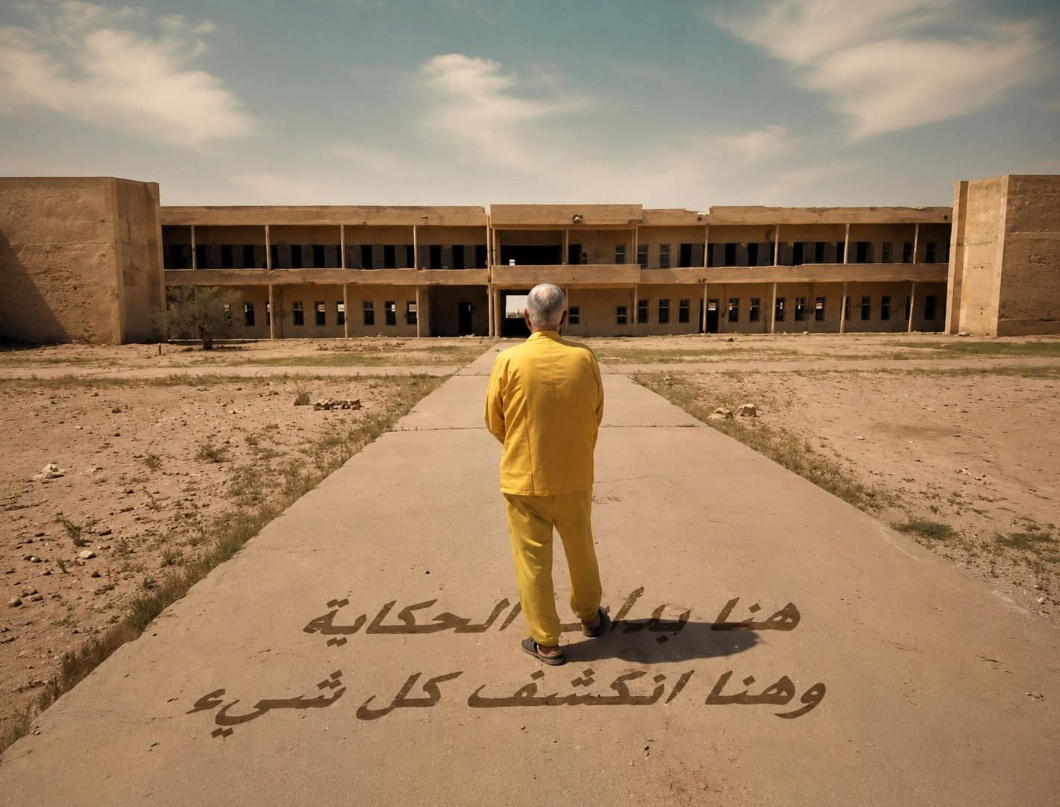
he Death Sentence Against Ajaj and the Issue of Reparations for the Victims of the Kurdish Genocide
A Legal Reading within the Framework of Transitional Justice
The decision of the Iraqi High Criminal Court concerning Ajaj Ahmed Hardan Zuhair al-Ubaidi is not merely a punitive judgment against an individual. Rather, it is a decision that must be examined at two levels: the punishment of the perpetrator, and the right of the victims and their families to compensation.
1. The Content of the Judgment
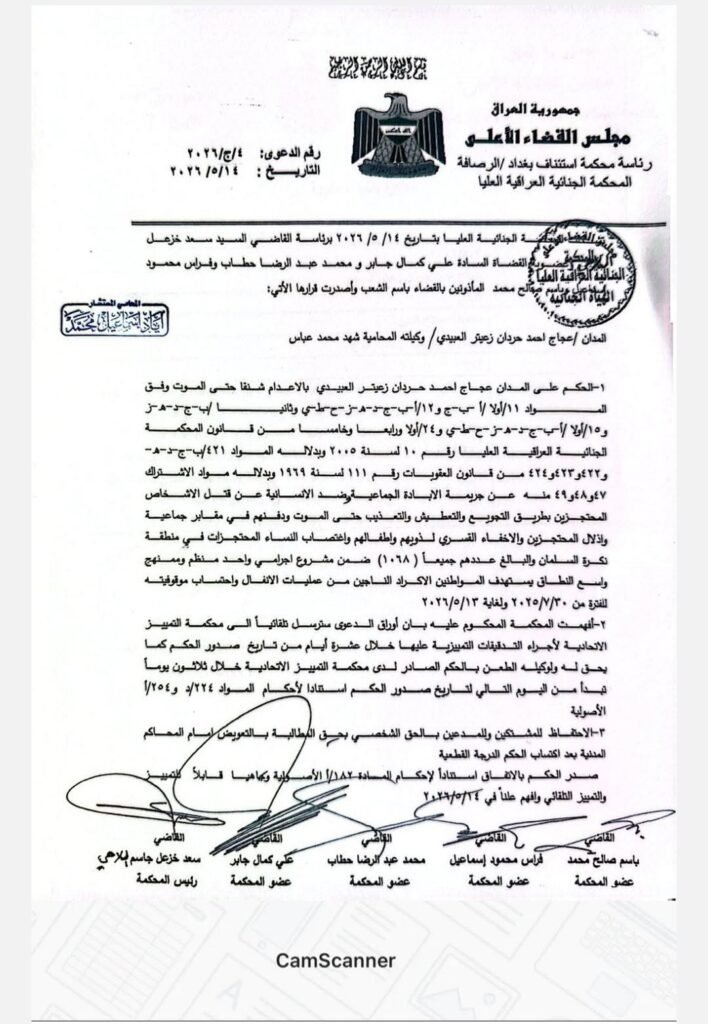
According to the judgment, on 14 May 2026, the Iraqi High Criminal Court sentenced Ajaj Ahmed Hardan Zuhair al-Ubaidi to death by hanging. The judgment was issued pursuant to the Law of the Iraqi High Criminal Court, Law No. 10 of 2005; the Iraqi Penal Code, Law No. 111 of 1969; and the relevant provisions concerning participation in a crime.
The judgment describes the acts of the convicted person as forming part of genocide and crimes against humanity. These acts included killing detainees by starving, dehydrating and torturing them to death; burying them in mass graves; humiliating detainees; forcibly disappearing girls and children; and sexually assaulting detained women at Nugra Salman Prison.
The judgment states that the number of persons addressed in this case reached 1,068. It is therefore necessary to state this precisely: 1,068 persons within the framework of this particular case, not the total number of victims of the Anfal Genocide.
2. The Right to Compensation in the Final Part of the Judgment
The final part of the judgment states that the rights of the complainants and claimants in the case are preserved, enabling them, once the judgment has acquired final and binding status, to seek financial compensation before the civil courts.
In other words, at the criminal level, the court identifies the perpetrator, establishes that the crime occurred, and imposes a criminal sentence. However, it leaves the compensation of victims and the assessment of damages within the jurisdiction of the civil courts.
3. Law No. 10 of 2005 and the Question of Compensation
Regarding its recognition of genocide, crimes against humanity and war crimes, Law No. 10 of 2005 is consistent with the principles and practices of international criminal courts. At the level of punishment and criminal responsibility, the law deals with grave international crimes.
In the area of compensation, referring claims to the civil courts is not unusual. In the experience of many criminal tribunals, priority has been given to punishing perpetrators and recognising the crimes, while compensation for victims has been addressed through civil courts, domestic courts, political and legal agreements, or other mechanisms.
For the Kurdish case, however, this procedure alone is insufficient. The Kurdish case is not limited to a single, narrowly defined case. There are several officially recognised cases of genocide, crimes against humanity and war crimes, in addition to other crimes that have not yet been brought before a court.
Compensation for the Kurdish genocide must therefore not remain confined to individual civil claims. Civil courts may constitute one available avenue, but they must not be the only avenue. Compensation must be addressed within a collective, national and state-level framework.
4. International Examples: Punishing Perpetrators and the Limited Scope of Victim Compensation
Have criminal courts around the world generally served more to punish perpetrators than to provide broad compensation to victims?
Yes. Throughout the history of prosecuting international crimes, many courts have primarily worked to punish perpetrators, recognise the crimes and preserve the historical truth. They were not established to create comprehensive compensation mechanisms.
This does not mean that victims’ rights were disregarded. It means that, within the jurisdiction of those courts, collective and systematic compensation occupied a limited place.
Victims were therefore often compelled to seek compensation through domestic courts, political and legal agreements, special funds or other mechanisms.
Among these examples, in my view, the model used to compensate Holocaust victims—particularly interstate agreements, collective representation and a special compensation mechanism—is the most appropriate model for the Kurdish case. For the Kurds, this issue could be addressed through a formal agreement between the Kurdistan Regional Government and the Federal Government of Iraq, accompanied by a special law and a compensation fund.
A. The Nuremberg Tribunal and Compensation for Holocaust Victims
The Nuremberg Tribunal was established after the Second World War to punish Nazi leaders. Its primary purpose was to punish the perpetrators and recognise war crimes and crimes against humanity; it was not established to create a comprehensive system for compensating Holocaust victims.
Compensation for Holocaust victims was subsequently addressed through agreements and political and legal mechanisms. An important example was the Luxembourg Agreements of 1952, concluded between the Government of West Germany, the State of Israel and representatives of Jewish victims, particularly the Claims Conference.
This provides an important lesson for the Kurds: the Kurdish genocide must not be addressed solely through individual civil claims. The Anfal campaign and the other crimes of the Ba’ath regime were systematic, state-perpetrated crimes against the people of Kurdistan.
B. The International Criminal Tribunal for Rwanda — ICTR
The International Criminal Tribunal for Rwanda was established to prosecute those considered most responsible for the Rwandan Genocide. The genocide was perpetrated in 1994 as an organised and widespread crime.
Regarding compensation, however, the tribunal’s legal authority focused primarily on punishing perpetrators, rather than establishing a broad and comprehensive compensation system for all victims.
C. The International Criminal Tribunal for the Former Yugoslavia — ICTY
The International Criminal Tribunal for the Former Yugoslavia was established to prosecute war crimes, crimes against humanity and genocide committed during the wars in the former Yugoslavia.
Like the Rwanda Tribunal, this tribunal was primarily established to punish perpetrators, not to create a comprehensive compensation system for all victims. This demonstrates that punishing perpetrators alone cannot replace collective compensation and transitional justice.
D. The Special/Hybrid Court of Cambodia
The Special Court of Cambodia, established to prosecute the crimes of the Khmer Rouge, was a hybrid court. It operated within the framework of Cambodian law, but was created through an agreement with the United Nations and included international judges and personnel.
Victims participated in the court as civil parties. However, reparations were primarily collective and symbolic. They took the form of memorialisation, recognition of the truth, education and moral rehabilitation, rather than individual financial compensation for every victim.
5. The International Legal Basis of Victims’ Right to Compensation
Although the International Criminal Court—ICC—does not provide a direct avenue for most cases relating to the Kurdish genocide, victims’ rights to remedy and compensation constitute an important principle under international law and international human rights standards.
The United Nations Basic Principles adopted in 2005 affirm that victims of gross violations of human rights and international humanitarian law have the right to a remedy, compensation, rehabilitation, recognition of the truth and guarantees of non-recurrence.
This principle is important for the Kurdish case because it demonstrates that compensation for genocide victims must not be limited to a sum of money or a civil claim. Instead, it must be viewed within the broader framework of transitional justice, acknowledgment, truth and rehabilitation.
6. What Should the Kurdish Side Do?
The Kurdish side must present compensation for the Anfal Genocide and the crimes committed by the Ba’ath regime between 1968 and 2003 as a collective national case and a matter of victims’ rights.
The issue must be addressed through an agreement with the Federal Government of Iraq, as the legal and political successor to the former state, rather than solely through individual claims before civil courts.
1. Establishing a Regional/Federal Fund to Compensate the Victims of the Anfal Genocide
This fund must be established by law, have an annual budget, and operate transparently. It must provide victims’ families with material compensation, pensions, medical and psychological assistance, social support and educational assistance.
2. A Collective Mechanism, Not Individual Complaints Alone
Filing a civil complaint is a right belonging to the victims, but it must not be the only available avenue. A special law or a governmental or parliamentary decision is required to recognise Anfal victims collectively and implement their compensation through a national and regional/federal system.
3. Collective Representation for Victims’ Families
Following the model of the Claims Conference, a representative body should be created. It should consist of victims’ families, legal experts, genocide specialists, archivists and representatives of institutions in Kurdistan.
4. Recognising Compensation as Part of Transitional Justice
Compensation is not merely financial. It must include revealing the truth, returning victims’ remains, identifying victims, opening archives, establishing memorials and museums, teaching the Anfal Genocide in educational curricula, and demanding an official apology from the Government of Iraq.
5. Raising the Case to the International Level
The case must be comprehensively documented and presented to the United Nations, international parliaments, human rights organisations and institutions working in the field of transitional justice.
Conclusion
Compensation for the victims of the Kurdish genocide in general, and the Anfal Genocide in particular, must not be confined to individual claims before civil courts.
Genocide is a systematic and state-perpetrated crime against a national group. Therefore, the response must also be systematic, collective and national.
Just as compensation for the Holocaust did not remain confined to the Nuremberg Tribunal and individual claims, but was addressed through agreements, collective representation and special mechanisms, compensation for the Kurdish genocide also requires a compensation fund, special legislation, collective representation and transitional-justice mechanisms.
Linguistic Note
The Arabic text of the judgment uses the term «الأكراد». Linguistically, however, the appropriate terms are «الكورد» or «الشعب الكوردي», just as the Arab people are referred to as «الأعراب».
Leave feedback about this