


Education for Memory, Identity, and Justice
Introduction
Genocide is not only a historical event; it is a deep national, human, and social wound. For a nation such as the Kurds, whose modern history has been marked by Anfal, chemical attacks, forced displacement, village destruction, enforced disappearance, Arabization, and mass graves, teaching genocide to new generations is both a national and educational responsibility.
However, this education must be age-appropriate. Primary school children should not be exposed to graphic details, frightening images, or violent language. Instead, they should learn through stories, gentle images, names, flowers, trees, families, schools, language, culture, and empathy.
The purpose is not to soften historical truth, but to communicate it in a way that children can understand. Such education should help children feel pride in their Kurdish identity, respect the victims, understand the meaning of injustice, and remain far from hatred, fear, or revenge.
Target Age Group:
Primary School Children
At the primary school level, the aim is not for children to know all the historical and legal details of genocide in depth. Rather, the aim is to build within them the basic principles of respect for human beings, recognition of difference, pride in Kurdish identity, preservation of memory, and a sense of justice. Historical, documentary, legal, and political details can be introduced gradually and in a more scholarly way at the intermediate and secondary school levels.
1. International Experiences in Genocide Memory Education for Children
In countries and communities affected by genocide, and in major international memory institutions, genocide education for children is usually gradual and age-appropriate. The experiences of the Holocaust, Cambodia, Bosnia, and Rwanda show that genocide education should not begin with fear. It should begin with people, identity, life, and memory.
The Holocaust
In Holocaust education, especially for younger children, teaching often begins with the ordinary lives of victims: family, school, friends, games, letters, photographs, and personal memories. The aim is to help children understand that the victims were not numbers; they were human beings with names, dreams, families, and lives.
In this approach, the focus is on empathy, respect, difference, rights, memory, and responsibility rather than graphic scenes or painful details.
Cambodia
In Cambodia, after the genocide committed by the Khmer Rouge, education became part of preserving memory and teaching the new generation. Documents, testimonies, archives, and family stories are used to help children and young people understand how hatred, lies, discrimination, and unlimited power can lead to mass crimes.
This experience is important for Kurdistan because an archive should not only be a place for preserving documents. It should also become a source of education, learning, and the protection of collective memory.
Bosnia and Srebrenica
In the experience of Bosnia, especially Srebrenica, genocide education is often built around three principles: remembering, learning, and pledging. This means that the new generation remembers the victims, learns about the causes of hatred and discrimination, and pledges to stand against injustice and discrimination in their own lives.
This model is also highly suitable for the Kurdish genocide:
We remember.
We learn.
We pledge that injustice must never be repeated.
Rwanda
In Rwanda, after the 1994 genocide, peace education and empathy became important parts of rebuilding society. Children are taught that hate speech, discrimination, and humiliation may begin with small words and behaviors, but they can grow into great danger. At the same time, children learn that empathy, respect, and education can help prevent violence.
For Kurdistan as well, teaching genocide should not be only a history lesson. It should also be an education in human rights, peace, identity, justice, and responsibility.
2. The Specific Nature of the Kurdish Genocide
The Kurdish genocide has its own specific characteristics. It was not limited to killing or disappearance. It included several forms of state crime:
Anfal, chemical attacks, village destruction, forced displacement, enforced disappearance of families, mass graves, Arabization, the prohibition of village life, and attempts to erase Kurdish identity.
During Anfal, villages, towns, and families were targeted through an organized policy of the Ba’ath regime and the Iraqi state. During the chemical attacks, even clean air, life, and the safety of innocent civilians were turned into targets. This makes the Kurdish genocide one of the gravest examples of state crime against a people.
However, for primary school children, these truths must be presented in protected and age-appropriate language. Graphic details of suffering, death, graves, or frightening scenes should not be placed at the center. Instead, children can be told:
“Once, an unjust authority tried to break Kurdish life. Villages, families, language, and even clean air were targeted. But the Kurdish people were not erased. Their language remained, their names remained, their memory remained, and today we learn this history for justice and to make sure it never happens again.”
3. National Education: A Gentle Approach Does Not Mean Weakness
When teaching the Kurdish genocide to children, an important question arises: Does a gentle and age-appropriate approach weaken national feeling?
The answer is no. A gentle approach in children’s education does not mean weakening historical truth. It means protecting the child’s heart and mind. Primary school children are not yet ready to receive the harshest details and frightening images of genocide. However, they are ready to learn that the Kurds are a people with language, land, mountains, culture, memory, and the right to life.
As a stateless nation, the Kurds need a strong national education system. This education should teach children to:
be proud of their Kurdish identity,
protect their language,
know the history of their people,
respect the victims of Anfal and chemical attacks,
And understand that national memory is part of justice.
But this feeling should not be built on hatred, revenge, or fear. Strong national feeling does not mean teaching children to hate other people. It means helping them know themselves, understand their people’s rights, and grow with justice, humanity, and respect for all human beings.
4. Life, Memory, and Justice: An Educational Model for KGNA
For the Kurdistan Genocide National Archive — KGNA, this approach can be shaped into an educational model based on three principles: Life, Memory, and Justice.
“Life, Memory, Justice”
First: Life
Lessons and stories should begin with ordinary life: villages, schools, children’s games, Kurdish songs, the Kurdish language, Kurdish clothing, families, mountains, springs, gardens, and homes. This helps children understand that the victims were not only numbers. They were people with lives and dreams.
Second: Injustice
In simple words, children can be told that during a certain period of history, the Ba’ath regime and the Iraqi state committed great crimes against the Kurdish people. During Anfal, villages and families were destroyed and separated. During chemical attacks, even the air and the right to life were targeted.
Third: Memory
Children should learn that memory is not only sadness. Memory means respect. It means protecting names, language, land, and the rights of victims. Planting flowers, writing names, preserving family photographs, listening to the stories of elders, and building archives are all part of protecting collective memory.
Fourth: Justice
Genocide education should not only say, “We suffered.” It should also say:
We demand truth, justice, reparations, respect for victims, and non-recurrence.
Fifth: Hope and Survival
Children should not only see victimhood. They should also see survival and continuity. The central message should be:
“The regime wanted to erase the Kurds, but the Kurds remained. Their language remained, their names remained, their memory remained, and today we protect this history through learning, knowledge, and justice.”
5. Guidelines for Writing Kurdish Genocide Stories for Children
Stories should:
begin with a child, a family, a village, or a school;
begin with ordinary life, not with the crime;
use simple and beautiful language;
avoid frightening scenes and graphic details;
place identity, language, Kurdistan, villages, mountains, family, and memory at the center;
Present Anfal and chemical attacks in age-appropriate words;
End with hope, flowers, trees, peace, justice, and national pride.
6. Sample Story for Children
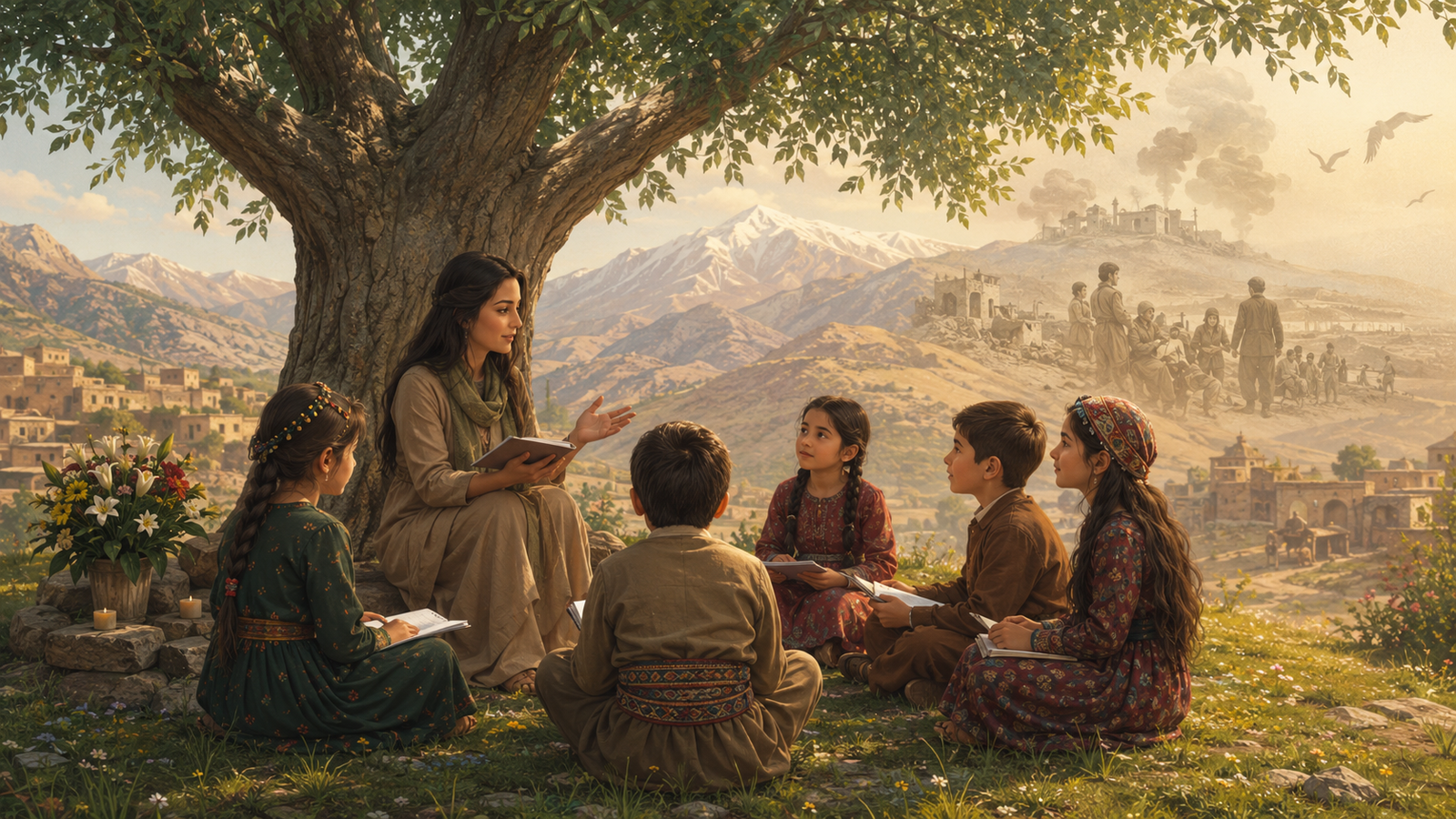
Title: The Tree of Memory
In a beautiful village in Kurdistan, there was a large tree. Every day, children played under its shade. Mothers and fathers gathered there and told old stories and sang Kurdish songs.
One day, the teacher said to the children:
“This is not only a tree. This is the tree of memory.”
A child asked:
“What is memory?”
The teacher answered:
“Memory means that we do not forget our people, our villages, our language, our songs, and those we love.”
Then the teacher said gently:
“Once, a great injustice happened to the Kurdish people. During Anfal, many villages and families suffered. During the chemical attacks, even clean air was targeted. But our people were not erased. Our language remained, our names remained, and our memory remained.”
Each child placed a flower under the tree. One of them said:
“We will not forget.”
The teacher smiled and said:
“This is the best lesson of memory. To learn is to protect.”
From that day on, the tree became a place of remembrance. Every year, the schoolchildren visited the tree, placed flowers under it, and said:
“We are Kurds. We protect our language and memory. We respect the victims. We ask for justice. Injustice must never happen again.”
7. The Main Message for Kurdish Children
We are Kurds.
We have a language, land, mountains, villages, cities, songs, and memory.
In our history, we have suffered great injustice.
Anfal and the chemical attacks are part of this painful history.
But our people were not erased.
Our language remained.
Our names remained.
Our memory remained.
Kurdistan remained in our hearts.
We learn because learning is protection.
We remember because memory is justice.
We are proud to be Kurds, but we do not hate any people.
We want injustice never to happen again.
Conclusion
Teaching the Kurdish genocide to children should be neither frightening nor emotionless. It must protect three goals at the same time:
protecting the child’s emotional well-being,
strengthening national identity,
and teaching memory, justice, and non-recurrence.
The experiences of the Holocaust, Cambodia, Bosnia, and Rwanda show that children can learn about genocide, but they must learn it in their own language, at their own age level, and in a way that helps them grow not in fear, but in identity, empathy, memory, and justice.
For Kurdistan, this education should become part of national and archival work. The Kurdistan Genocide National Archive — KGNA can develop this into a scientific, human, and national program for the new generation, so that Kurdish children know:
who they are,
What happened to their people?
why memory matters,
and how learning and justice can build a better future.
Sources
This article draws on educational and historical resources from the United States Holocaust Memorial Museum (USHMM), Yad Vashem, UNESCO, the Documentation Center of Cambodia (DC-Cam), Aegis Trust Rwanda, Remembering Srebrenica, the Organisation for the Prohibition of Chemical Weapons (OPCW), and Human Rights Watch’s report Genocide in Iraq: The Anfal Campaign Against the Kurds.
Leave feedback about this